Healing, Latino culture, NaNoWriMo, NaNoWriMo Comics, Writing

Who Really Uses NaNoWriMo?


NaNoToon
NaNoToon

Who writes 50,000 words in 30 days during November?

Crazy writers. Passionate writers. Driven writers.

Writers who have trouble keeping their butt in the chair and hands on the keys use NaNoWriMo (National Novel Writing Month) as a last ditch effort to focus.

Completion rather than perfection is the goal.

We wait, crunked up on leftover trick or treat candy, swigging an energy drink, ready for the clock to strike midnight.

Who are these crazy people pushing their pens, tapping their computer keys at 12 a.m on Halloween night?

We are the Nano’s, peculiar writer beings who believe we can write 50,000 words in 30 days, November 1st to November 30th.

Really, we do believe.

This year I’m actually adding to last year’s draft. The working title for this New Adult novel is La Curandera*. Here’s my logline and a description:

Three generations of women, three broken hearts, one love potion.

Violet Romero is just as ambitious as her father, the city mayor. She has a five and ten-year plan to become the young politician who will change the world. That’s the strategy until her fiancé dumps her for her best friend and she spirals into depression, dropping out of her master’s program. Now she’s on the verge of losing her summer internship at the state capitol.

When she finds a job at a shop that specializes in cures, spells, and potions, run by two curanderas, she decides to take matters into her own hands and concoct her own remedy. But when Violet’s love potion causes her ex-fiancé to fall in love with her mother, and her grandmother’s 70-year-old love interest falls for Violet instead, she has to make things right again. She must travel to Mexico to seek a 100-year-old curandera who possibly has the cure if Violet can accomplish a vision quest.

I’m using this photo as inspiration to write:

The Healing Arts of Mexico by German Rubio

I have my storyboard up on Pinterest for more inspiration.

So this writer will use the next 30 days to complete the story because I am driven, passionate and crazy about writing.

This means much less time on social media and no blogging for 30 days (unless there is a blogging emergency).

See you next month. Happy November!

*Curandera: Traditional healer who uses centuries-old herbal remedies for a variety of ailments. A spiritual element is also part of the healing. Usually, the healers are generational and native people of Mexico, Central, and South America.

 

Day of the Dead, Family, Latino culture, Latinos in film

Day of the Dead in the U.S.A

Day of the Dead
Day of the Dead

The Latin American tradition of “el Dia de Los Muertos,” has crossed over to the U.S. as Day of the Dead (DoD) Celebrations are in more cities and cemeteries than ever before.

One can find DoD items at Williams-Sonoma, Cost Plus World Market, Target, Michael’s, and several other stores. The day has been commercialized and is now part of big marketing just like Halloween and other holidays.

I have mixed feelings about all that and hope the tradition doesn’t get lost through merchandising. I don’t want people to think that DoD is Mexican Halloween because it isn’t.

You might wonder what’s up with Mexican culture and death. And how did the celebration come to the U.S?

This is a story as old as immigration and ancestral traditions.

In the 1970’s Latino activists and artists in the United States began expanding “Day of the Dead” north of the border with celebrations of performance art, Aztec dance, art exhibits, and other public expressions, namely the construction of the altar.

This tradition, embraced by the mainstream, builds community, gives awareness for other traditions, and helps maintain ancestral and cultural identity.

There are several icons which constitute a Day of the Dead remembrance.

Recently, museums across the nation have begun to embrace this tradition as a means of engaging more diverse audiences and highlighting how Latin Americans view death, in contrast to Anglo-Saxons.

My county museum has been celebrating Day of the Dead for several years. This year, I and several others are building an altar to the Mexican and Mexican American film stars of the past 100 years, as a precursor to a film festival we’re hosting next year.

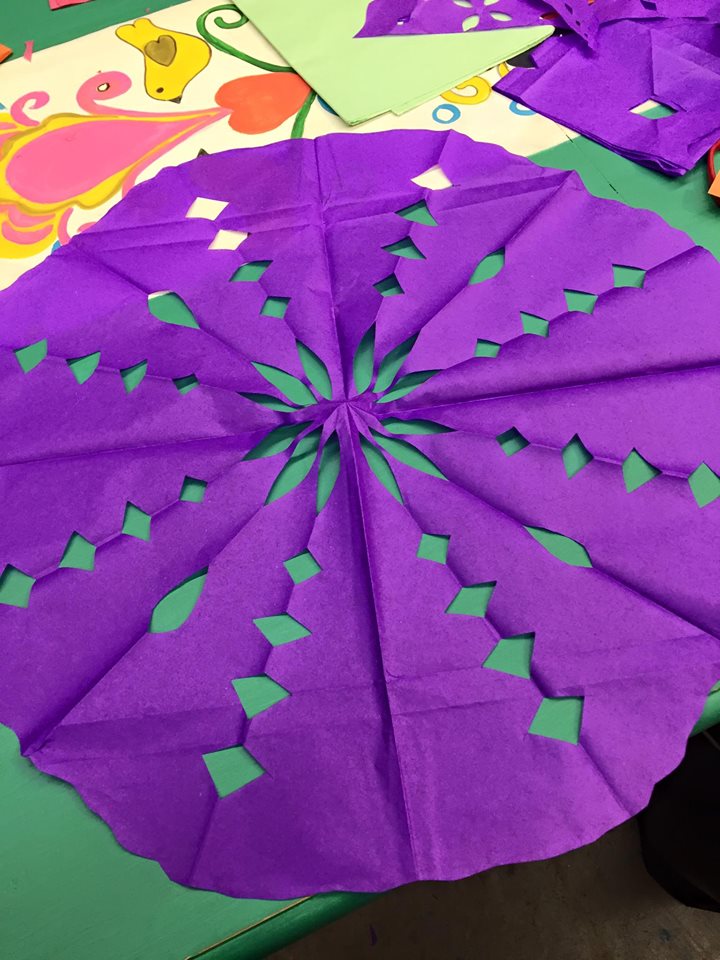
First we had to fold and cut a lot of colorful crepe paper to decorate the three levels of the altar. I’m a craft klutz, but with some individual help, I was able to construct a few papeles.

Papel Picado
Papel Picado

Some handiwork from my friends:

Heart and Diamond cuts on Papel Picado
Heart and Diamond cut on Papel Picado

As you can see, just building the altar brings a group together.

Over the next few days, we’ll gather the elements needed to symbolize the four elements: wind, water, earth, and fire. Bunches of cempasuchil (marigolds), photographs, jarros (earthenware jugs or cups), candles, salt, pan de muerto (bread of the dead), sugar skulls and a few other objects.

Here’s a close-up view of a small altar.

Example of Day of the Dead altar.

Expand your horizons and visit a Day of the Dead celebration in your area.