Elmore Leonard, purple prose, Revision, slow passages, Stephen King, Toni Lopopolo, Writing

Want to Write Better? Kill Your Darlings

The first time I heard the saying “Kill your darlings,” was when writing boot camp instructor, Toni Lopopolo, held up an 8×12 poster with a big slash over the words. The words originally came from Sir Arthur Quiller Couch:

‘Whenever you feel an impulse to perpetrate a piece of exceptionally fine writing, obey it—whole-heartedly—and delete it before sending your manuscript to press. Murder your darlings.’

William Faulkner paraphrased the quote to:


                                                       “In writing, you must kill your darlings.”


Stephen King, yes that SK, reiterated this advice in his book “On Writing.” The use of KYD is one of the first things he recommends after a first draft. To get to a second draft  he suggests cutting the first one by 10%. You can easily start with KYD.


And last but not least, Elmore Leonard’s take on this:

         ” …kill your darlings, kill your darlings, even when it breaks your egocentric little scribbler’s heart, kill your darlings.” 


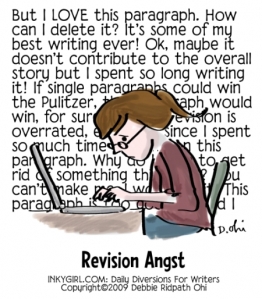
Darlings are those beautiful bits of prose, a character, or setting that you just love. It can be a wonderful turn of a phrase, an insightful nugget of wisdom, a character, unique adjectives or adverbs. Sounds so precious, right? In and of themselves they sure do, but alas, they don’t fit in the story. They’re filler words, setting, dialogue, or characters. 


                            The words aren’t there to fulfill word counts- every word must count.


It’s important not to get so attached to these scenes or dialogue that you can’t bring yourself to cut them for the sake of the overall story. Another piece of advice that Stephen King and many other authors give: put your first draft away for 4 to 6 weeks then look at it with fresh eyes and mind. After some distance you may recognize the KYD’s that snuck into your draft. 


The KYD’s to look for are: 

  • Ineffective Dialogue: it rambles, is dull, makes small talk, or enters the rabbit hole
  • Telling: there is so much narrative there are blocks of black-show don’t tell
  • Purple Prose: flowery, fifty dollar words when simple, straightforward is enough
  • Slow passages: another ramble and the reader yawns or skips-slows pace
  • Characters: who don’t further the plot or is unimportant to story
  • Verb/Adverb combo: too many results in weakened writing-go for the strong verb

When you find these intruders….Kill ’em. 
If you want to show some mercy, then cut and paste them onto a document you title “Sneaky B’s,” or other such reminder. You may want that evicted character you worked on for months to go in another story. That beautiful or dark setting may work somewhere else. 

I know this is a difficult thing to do. If you can’t bear to KYD’s, have someone you trust read and wield the red pen. It’s only red ink, not blood, you can take it. 

How do you KYD’s? I’m interested to know since I have two MS’s in revision and I’m giving myself a deadline.  


Cutting scenes, Revision, Scenes, Writing

Scene Slashing

Every Saturday morning I travel thirty miles to my writing class in beautiful Summerland, that tiny resort village next to small but chic Montecito, California. For three hours or so I sit at a table, sometimes like the one above or a folding table, with coffee in a cup twice the size of the one above. I look forward to the class, I like everyone there and enjoying hearing the 5 to 10 pages the other six writers bring to share. That is until last Saturday.


It wasn’t them, it was me. I read a three page jail scene that I thought had realistic detail, created a ‘jail like ambiance’, and I thought it was important to the story, after all the protagonist had just been arrested for driving under the influence.


Hit the buzzer, uh….wrong. My instructor, who’s usually mellower than mellow immediately said,


“What is this scene for? How is it relevant to the story…You should have gotten that out of your system with the Juana story…” (reference to a second manuscript about prison). I could have sworn a look of disappointment crossed his face and I hadn’t seen that look before when I read. No one else said a word. It was the last ten minutes of class so I understand that we had to go on. The next person didn’t fare any better either. Instructor repeatedly asked “No story yet…no story yet…” until the writer hit the place where the story really began.


My instructor has written several books and is highly esteemed in writing circles. I know he was correct in what he said, but- yes there’s the but- the scene was written for a reason. I just had to think about it.Not think about the instructor comments, but remember why the heck I had written that scene and kept it in several revisions.  I’ve been doing a lot of scene slashing in the past two months, so there must have been a reason I kept that one. Then it dawned on me, I failed to get across the message in terms of what scenes are supposed to communicate.


I returned to my teachers latest book, “The Fiction Lover’s Companion,” and looked up “The Scene.” I hadn’t read that far yet, but it’s no excuse. This is what he said:


     “The character in the scene has to have an agenda and expectations…a segment of dramatic engagement in a particular setting where personalities and goals collide, producing a sense of movement toward a resolution or trial. There has to be something in the scene to propel the story further…” (TFLC).


Sol Stein, in “Stein on Writing,” says a scene should be “…an integral incident with a beginning and end…action and dialogue.” In “Manuscript Makeover,” the problem scenes have no clear goal, minor goals with insignificant matters, passive, or the obstacle is absent. 


Holly Lisle, creator of “One Pass Manuscript,” says the scene belongs if it address your theme or one of your sub-themes, contains action, conflict, and change, develops one or more of your characters and moves your story forward. ” Even if the scene involves your two main characters, but they’re carrying out action that has nothing to do with what your story is about, does not develop them as characters, and does not move the main story conflict or address any of the sub-themes, cross the whole thing out.”


After reading those definitions, there was no more pondering about what I had to do. There were three elements I wanted to get across but I failed to do so and they did meet the criteria of an important scene. I’d overwritten the scene and got caught up in making it real, instead of concentrating on the reasons the scene needed to be there in the first place. It was easy to make a list of important elements to include but harder to decide how to incorporate them into the jail scene.


I re-wrote the scene and sent it off to a trusted writing friend to ask for her opinion. She’s in my writing group so she heard the discussion. If the revision doesn’t make it as a scene, it has to be slashed and put on the burn pile, like so many others. Whether I love it or not. At least I’ll feel I gave it a good ‘trial,’ before I sentenced it to death.