

One of the greatest rewards of attending A Room of Her Own (AROHO) writer’s retreat was the ability to listen to writers I’ve long admired. One of these writers is Janet Fitch, the author of a beloved book of mine: White Oleander.
When I read White Oleander, back in 2001, I was working with youthful offenders in a correctional facility. Most of them had been in the foster care system (like the protagonist in White Oleander). I often wondered how this writer managed to capture the loneliness and sense of hopelessness felt by foster kids and put these feelings into a poetic narrative.
This quote is one of my favorites:
“The pearls weren’t really white, they were a warm oyster beige, with little knots in between so if they broke, you only lost one. I wished my life could be like that, knotted up so that even if something broke, the whole thing wouldn’t come apart.” ― Janet Fitch, White Oleander
While at AROHO, I was too awe-stricken to approach Janet Fitch and let her know how much her book meant to me. Her book was one of the reasons I wanted to begin to write. I must confess that my “awe-struckness” diminished when I observed how down to earth Ms. Fitch carried herself among the group. She sat in the audience like the rest of us, mixed and mingled, strolled the grounds without an entourage, and pleasant to everyone. I relaxed even when I ended up sitting next to her at a presentation. I didn’t take the opportunity to tell her how much I love her writing (I’m a classic introvert).
My “awe-struckness” reared its head again when I inadvertently caught up with her on a stroll down a dirt path. For four days I planned to walk the labyrinth and rake the zen garden. During break time I hustled down the road towards the labyrinth. The woman slightly ahead of me wore a very cool, tightly woven black and white sun hat. I commented on the hat. Janet Fitch turned around and replied, “Thank you.” She then proceeded to tell me that she found my presentation, the night before, powerful and advised me to send my writing to a journal, giving me the specific title and editor’s name. I had to work at closing my mouth while I nodded in appreciation. She was trying to find a place to paint and we walked until we found the right place for her to paint the mountain behind the labyrinth.
But I digress. Back to the title of this post. Later that day Janet made a presentation “Writing from the neck down.” Her first point was that most writers stay “above water,” when writing.
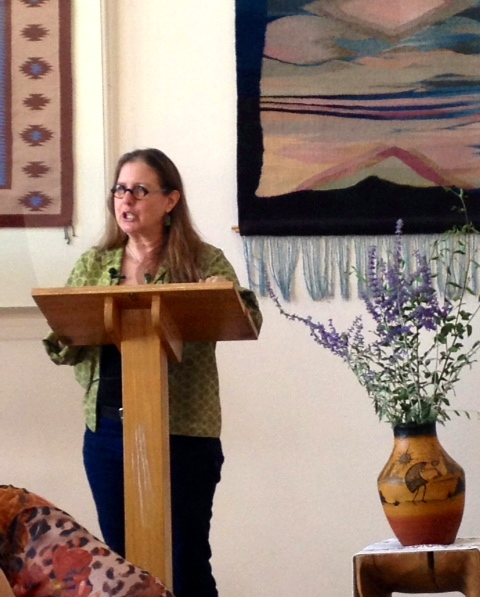
“We have to write about the 9/10’s that are beneath the water.”
So how do you get below the waterline to write the deep stuff, the emotional, the essence that writers need to put on paper?
- by chance, synchronicity, by opening yourself up
- write down a word, then question it: “…it was high,” well how high was it?
- write down the emotion and ask what does that emotion mean? use the word as a prompt, write it out, draw it out, paint it out
- let your writing go, incorporate what you smell, feel, hear, touch, taste and see around you
An interesting story Janet talked about was her muses. She has five great authors she sits with for tea (in her imagination) in her parlor. She asks them questions about the work she is creating. Unfortunately, I didn’t capture all five but here are four to give you an example.
- Dillon Thomas-she goes to him about words
- Carl Sandburg-she discusses humanism
- Sei Shonagon (11th Century Japanese writer/poet)-she discusses beauty
- Sor Juana-I’m not certain but I think it was for her poetry
When it comes to writing novels, she says that she does a visual meditation about the protagonist and asks the following:
- “What’s up with you?” and then listen
- Interview your character. Jot down what you hear
- “What do you want me to say for you?”
Now, write a scene. Now another-keep going.
Did you move your protagonist from one scene to the next using the senses, emotions, and her inner world? If you did, these exercises helped. If not, well, go back and meditate a little more or take a slow walk and be amazed at the hundreds of things around you. Touch the leaves of a flower, photograph outstretched branches, look at the clouds, see your reflection in the water. Go and seek out the miraculous.
You can visit Janet FItch’s blog to find valuable tips such as ” 10 Writing Tips That Can Help Almost Anyone.”
You will also find this blog, by fella AROHO writer Barbara Yoder, filled with more info about writing from her small group sessions with Janet Fitch.
“Live like a poet. See the world differently. Search for the miraculous. Be more amazed.”- Janet Fitch
Thanks for stopping by and write on.


 alvaradofrazier.com