Blog

Family, Latino Family Traditions, Lent, Mexican Cooking, Mexican Holiday foods, Mexican Vegan food, Roman Catholics

When We were Catholic-Lent

by J. Cobb
My mother is Roman Catholic. She baptized and raised us as such. We attended Catholic schools from first to twelfth grade. Everything you can imagine in the 1960’s-70’s era of Catholicism, in our Latino home, we had it: Virgen of Guadalupe, St. Jude, and the Sacred Heart of Jesus statues. We had an altar under the niche in the stairwell.Wooden crucifixes, lit votives, rosary beads, and brown scapulars dotted our rooms along with framed pictures of the Pope, JF Kennedy, and Cesar Chavez. The parish priest came to our house for dinner. That’s how Catholic we were in those days.  

Now, three of the four of us are Christian and the other doesn’t affiliate with any denomination. We don’t practice the Lenten season like we used to ‘back in the day,’ the Roman Catholic way. But my mom still asks us every Ash Wednesday “…where are your ashes.” Don’t you commemorate that Jesus died? Don’t you fast? Do you eat meat? Surely you give up something-chocolate? wine?
She’s legally blind so we could lie and say we had them but they smudged, but come on who’d lie on Ash Wednesday. For a couple of years we’ve explained that our Christian denomination doesn’t practice the marking of ashes on the forehead, but that soon leads to an argument. It’s her way (the Catholic highway) or no way. 
No use in arguing with my mother about religious doctrine versus biblical scripture. So we look for common ground. Yes, we assure her that we do believe Christ died and rose again, we can fast, we can make this a season of service, and introspection. “That’s good,” she says. “But what about the food?”
Yes, the Lenten food we made in the (Catholic) past will still be made during the Lenten season. But it’s not reserved for the Friday’s of Lent. The food has become part of our family tradition, except for the fish sticks.   
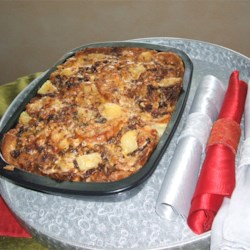
When we were Catholic we ate comida Cuaresmena (food of Lent): tortitas de camaron (shrimp patties), nopales (cactus), chile rellenos and Capriotada (bread pudding). We also ate a lot of potatoes, beans, and vegetable soup, but they weren’t half as good or as special as the one’s mentioned.  
Shrimp patties photo by MexicoCooks.com
Capriotada-photo by Janie R.

This is my sister Debbie’s recipe for Capriotada:

Ingredients
sliced French bread( regular or sour dough), piloncillo (raw sugar cone), dark brown sugar, cinnamon sticks, raisins, walnuts, shredded Monterey Jack cheese, oil/butter or spray oil , and water.

Pour 6 cups water in large saucepan, stir in one piloncillo, 4 whole cinnamon sticks, and 1/2 cup brown sugar. Use medium heat and bring to a boil. If you want it sweeter add 1/2 cup brown sugar. Reduce heat and simmer 10 minutes. Add raisins during last 3 minutes if you want them softer. Discard cinnamon sticks before pouring syrup on bread.

Coat a 13x 9 oven proof baking dish with cooking spray, butter or oil. Preheat oven to 350.
Layer bread in pan and pour on syrup, layer with grated jack cheese and walnuts. Proceed with layering until the loaf of bread and all the syrup is gone. Bake for 30 minutes, if too soggy, bake another 15 minutes. 

Serve warm or chilled. For Vegan Son I use a non-diary cheese or leave out the cheese. Some people use only pillocillo, almonds, and Mexican Cotija cheese. It’s a matter of taste, just like it’s a matter of how you practice Lent. 

I’m hungry now, so I’ll post some of the other recipes at a later date. 


fiction, Renni Brown, self editing, Writing

Why Novels Go into the Dog Pile

In the past two months I’ve read seven books. Okay, read is not the correct word. “Attempted to read,” is more accurate. I tossed four books into the ‘no read’ zone after the third chapter. This was two chapters too late. 


Four of the seven books are self-published and on Amazon. Of these three are first time authors. Three are ‘traditional print’ books with one first time author. 

photo by N. Rigg

Three of the books no longer occupy virtual shelves on my Kindle Fire. Two of the printed ones has a home on the bottom shelf of the bookcase–for now. They are all in the dog pile. At least on the Kindle the virtual poop doesn’t smell or take up space. 


I hated to do it but I couldn’t read the novels anymore. It’s unfortunate that two of them are ARC’s* for book reviews. I pushed myself through two (one an ARC) because the stories had me fascinated. Only one book out of seven, Catherine Ryan Hyde’s When I Found You, made the list of well written reads and retains a place on the physical book shelf.  


The proliferation of useless words and overuse of adverbs (the -ly’s) slung four books into the dog pile. I felt bad dropping those books. I’d feel worse slugging through the novel until the end. What did these less than desirable novels have in common? 

by MAlvaradoFrazier-Click to enlarge

The novels came peppered and over salted with useless words. The ‘-ing’s’ at the beginning of sentences drove me crazy. The ‘As’s’ all over the place made me cross-eyed. One writer used “Suddenly” in every chapter. Several writers had passive sentences on every page. After a dose of these needless words my interest waned. They took me out of the story. I spent more time rewriting the sentences in my head. 


I’m guilty of every one of those words on the graphic. My first manuscript came back drenched in a red sea of edits, you’d thought I typed in red. It wasn’t about using correct grammar, it was about passive sentences, the overuse of adverbs, and the ‘as’ construction. 


It took one book (recommended by the person who did the edit) to set me straight on this subject: Self Editing for the Fiction Writer: How to Edit Yourself into Print. Renni Brown and Dave King’s book Self-Editing devotes a chapter titled Sophistication to illustrate: 


     One easy way to make your writing seem more sophisticated is to avoid two stylistic constructions that are common to hack writers, namely:
Pulling off her gloves, she turned to face him
or
As she pulled off her gloves, she turned to face him.

     Both the “as” construction and the “-ing” construction as used above are grammatically correct  and express the action clearly and unambiguously.  But notice that both of these constructions take a bit of action (“She pulled off her gloves…”)  and tuck it away into a dependent clause (“Pulling off her gloves…”). 

This tends to place some of your actions at one remove from your reader, to make the actions seem incidental, unimportant.  And so if you use these constructions often, you weaken your writing.  (stronger writing?  She pulled on her gloves and turned to face him.)

Another reason to avoid the “as” and “-ing” constructions is that they sometimes give rise to physical impossibilities.  

“Disappearing into my tent, I changed into fresh jeans.”  The -ing construction forces simultaneity on two actions that can’t be simultaneous. The doctor didn’t duck into the tent and pull on pants at the same time. Better, stronger is:

I disappeared into my tent, found my jeans, and pulled them on. (Stronger writing and possible).

Do avoid the hack’s favorite constructions unless you have a good reason for using them.  And do catch all these things when you edit, not when you are writing.
And remember: The participle construction (Walking, Pulling, disappearing,  ing, ing ing) to begin a sentence) has a particularly AMATEURISH flavor when placed at the beginning of a sentence.


Writing, like a beautiful looking meal, is inedible when over salted. Do you have any ‘reading’ pet peeves you’d like to share? I’d like to hear them because anything that helps us become better writers is a good thing.


*ARC (Advanced Reading Copy)