
“One man taking on Goliath like forces in a fight for social justice.”*
This article is a two part series:
A couple of weeks ago I chatted with a friend about the need for more films by Latino filmmakers that highlight Latino accomplishments. This was on the heels of the Katt Williams tirade and the frustration of reading about a movie (see my post) which had Robert Duval playing a main character, Mr. Crawford, based on real life pro golfer, Johnny Arreaga. This had me thinking how the Latino community can get involved in pushing for more Latino films with Latino actors by Latino filmmakers and producers.
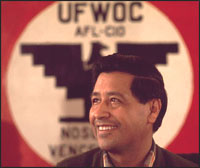
My friend mentioned filmmaker *Richard Ray Perez’s documentary, titled “Cesar’s Last Fast.” The film, structured around Chavez’s 1988 thirty-six day fast, calls attention to Cesar’s spiritual commitment, values, and humanity. There are eighty-five hours of never seen before footage about this fast, which includes Martin Sheen, Edward James Olmos, Ethel Kennedy, Jesse Jackson, and several other people close to César Chavez.

His political activism and leadership, grounded in non-violence, followed the teachings of Gandhi, Nehru and Martin Luther King. It was Chavez, who coined the phrase “Si, se puede.” His actions were a living example of a life dedicated to fighting for people who are among the poorest.
In my interview with Richard Perez, his passion for bringing Cesar’s spiritual commitment to light is evident. His goal is to illustrate how one person can better society through personal sacrifices. “César Chavez had the type of commitment few people have had in history. We hope to raise his profile, not as an ethnic labor leader, but as a spiritual leader. He was an incredibly unique man…his commitment has been largely overlooked.”
How Mr. Perez came upon this project is amazing for the connections to his past and present.
“My fellow producer … likes to say that I was destined to make this film. My father was a migrant farm worker for 22 years…My aunts and uncles, his siblings were all farm workers, too. And when I was 4 years old, attending Head Start in…San Fernando … there were some (CSUN) Chicano students who volunteer(ed) at the Head Start… about 1969, 1970… I noticed one day that one of those Chicano volunteers was taking his grapes out of the fruit cocktail out of the lunch that we got, the sort of free government lunch.
I asked him, ‘Oh, why are you doing that?’ And he said, ‘Well, because, the people who pick the grapes are treated very poorly by their bosses. They get paid very little money. They often have to live in shacks. If they complain, they get fired. It’s just a very, very hard job, and their bosses treat them horribly.’
I remember looking down at my grapes in my fruit cocktail and realizing that all of a sudden they looked very, very ugly. So I started picking the grapes out of my fruit cocktail. And pretty soon the rest of the students sitting at that table all did the same, and for the rest of the year none of us ate the grapes in our fruit cocktails that were in our lunch.”
Twenty some years later, Mr. Perez made a proposal to the César Chavez Foundation to make a documentary. They couldn’t give exclusive agreement because a similar project was in the works by filmmaker Lorena Parlee, PhD., Chavez’s Press Secretary. Dr. Parlee was a Professor of Mexican and Chicano History at the University of California’s Santa Barbara, Irvine and San Diego campuses. She had exclusive rights but asked if Perez would like to collaborate, but he was working on another project and said he could it in six months. He didn’t hear from her and months later, he received a telephone call from Dr. Parlee’s family. She had died from breast cancer and left instructions to contact Mr. Perez and give him the private videotapes to finish the project.
Mr. Perez and fellow filmmaker Molly O’Brien reviewed the footage and decided to focus on how he inspired a generation of people to participate in the struggle for social justice. They are close to two thirds completed and need to raise money to continue filming and editing this documentary.
They have coordinated a Kickstarter Campaign, a crowd funding method of raising funds. The campaign will launch on September 25, 2011, with a 60-day run. The goal is to raise $20,000. Click on this link to see a one-minute trailer and go to www.cesarlastfast.com for more information. Like them on Facebook too. After all, it takes a community.
 alvaradofrazier.com