Army of Women, Breast Cancer Action, Breast Cancer Fund, Breast cancer research, Chingonas, Dr. Susan Love, Health, HOW Study, October Breast Cancer Awareness, Un-Pink

How To Go Beyond Pink

I view Breast Cancer awareness from a UN-PINK perspective.This post may irritate a few people, but I’m going to go all chingona on this issue, which is near and dear to my own breasts.
from my collection-by Yrenia Ortiz
  

Last week I shared with you why I couldn’t look at Pepto-Bismol bottles without cringing. This is not from an ungratefulness for the work of Susan B. Komen of any of the several BC awareness campaigns. 

Fifteen years ago that’s what we needed. It got us from unawareness to marketing of the PINK.

The majority of the funding goes to science aimed at treating the disease once a woman has it rather than finding ways to keep her from getting it in the first place.  Article.

Undoubtedly, awareness campaigns and subsequent dollars for making chemo medicines saved thousands of lives, mine included. But what about now, in 2012? How do we go beyond PINK?

How do we change this statistic*?: 

In the 1970’s, lifetime risk of being diagnosed with breast cancer in the US was…1 in 10In the 2000’s the lifetime risk is 1 in 8. 

Maybe we can put aside the PINK for just a few minutes and go all out chingona for: 

Breast Cancer Action

1. WHY: isn’t donating money enough?  Did you know that breast cancer could be caused by a virus? Yes, read about it. We need research to find the cause, thus the cure. The organization “Think Before You Pink” wants you to be informed on where your donations go and how much.

 2. HOW: The majority of women who get breast cancer have none of the known clinical risk factors. This means we don’t know what causes breast cancer or how to prevent it. The Health of Women ( HOW) is a first-of-its-kind international online study for women and men with and without a history of breast cancer.

3. WHAT: can I do?  Partner with research scientists to move breast cancer beyond a cure. Army of Women is doing just that. I joined 2 years ago-it’s totally volunteer. It takes very little time, as few as three hours a year to a couple of hours a month. If someone needs low cost/free services direct them here.

4. WHERE: can my donations/actions make a significant difference? Donate for research for a CURE. Add your name, for stronger regulation and independent research, to this petition. 

5. WHEN:  can you  advocate for a cure? Any day of any month, not only in October. You don’t have to walk 60 miles in a sponsored event (but you can if you want-my sister, the exercise chingona, did). Encourage others to advocate and get educated. Show action by:

  • Participate in a study, 
  • sign a petition, 
  • shop for products where the majority of the money goes to research, 
  • educate yourself on high risk factors, 
  • get at least 30 minutes a day of moderate exercise, 
  • find out what chemicals are in your food/cosmetics/home 
Please understand that this post is my way of letting out my feelings about my own breast cancer journey, one that almost 7 years later, I am still on. (don’t get me wrong, I’m glad to still be around to walk the journey). But, it’s one that I’m reminded of every time I take my tiny white anti-estrogen pill. 

I want to grow older with my siblings and my loved ones. I want to see my kids get married, have grandchildren. Too many people are getting this disease, people who didn’t have ‘high risk’ factors, women as young as 28, friends, acquaintances...women are still dying. 

Be that person who takes action. Go all out chingona on this issue. 
breastcancerfund.org


*National Cancer Institute

2012 Olympics Chingonas, Brenda Villa, Chingonas, Claressa Shields, Marlen Esparza, Missy Franklin, Women of 2012 Olympics

The U.S.A Chingonas of the Olympics

all photos public domain

As the 2012 Olympics came to a close I thought about how much I am going to miss these games and these Olympians, especially the women who represented the U.S.A.

They won 29 of the team’s 46 golds. To put that in perspective: If the U.S. women were their own nation, they would be tied for third in the gold medal count with Great Britain.


Women who are high school students, mothers, and wives, took medals in track, swimming, soccer, boxing, water polo, swimming, beach volleyball, tennis, artistic gymnastics, pole vault,  judo, and skeet shooting.


These Olympians are chingonas of the highest degree. They train for most of their life, just for the opportunity and honor to represent their country. 

I call them chingonas because they fulfill the top 3 attributes defined by Sandra Cisneros in a presentation she gave at a conference: 

1. Live for your own approval. 

2 .Discover your own powers. What floods you with joy?

3 .Find true humility and practice it.

Some examples: 

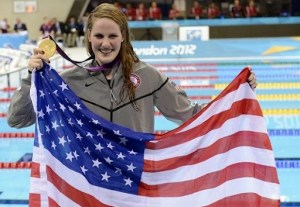
 U.S. swimmer Missy Franklin won the most golds of any woman in these Games — four — and added one bronze. This 17 year old, almost Senior in high school has decided not to turn pro and to forgo endorsement deals potentially worth millions to continue swimming for her high school and at the collegiate level.

“For right now, I still believe that college is what’s going to make me the happiest girl,” Franklin said at a U.S. Olympic Committee news conference.

Forty years after the passage of Title IX, a federal law that prohibits discrimination on the basis of gender, there is plenty of reason to celebrate. For the first time this year, women outnumbered men on the U.S. Olympic team. 

 “Does it give me an extra smile?” said Brenda Villa whose water polo team won the gold. “It does.”

Ms. Villa, 32 years old, grew up in Commerce, Calif. Villa participated in city sponsored programs where children didn’t have to pay to play sports..

That opportunity made all the difference to the three-time Olympic water polo medalist who has won three Olympic medals (two silver and a bronze) and has just completed her fourth Olympic Games, with a gold medal. 
As a co-founder of Project 20-20, she has paid it forward. This program provides swimming and water polo lessons to low-income people of the Bay area, where she served as a tutor during her days at Stanford University.
Middleweight boxer, Claressa Shields and Fly weight, Marlen Esparza won the gold and bronze medals. 
Seventeen year old Claressa  became the first woman and the only American boxer to win a gold medal. In a USA news interview she credits her grandmother:

My Grammy always said that girls can do the same thing as men. She said that I couldn’t do just everything, but she said up in sports, I should be looked at as just equal, so I should always do my best.” 

Marlen graduated high school as class president with a 4.6 GPA. She was accepted at Rice University and the University of Texas but put college plans on hold while she pursued boxing. She plans to call it quits on that career after the Olympics and attend medical school.
Although closing ceremonies have just completed, I may not have to wait long to see these women again. I’m sure they’ll be on every major morning show throughout the week, hopefully inspiring another generation of women athletes. 
Congratulations to all of the women who achieved greatness by their tireless training, their team spirit, and belief in themselves. They are Gold Medal Chingonas