

Ugh writing query letters suck. They are a necessity for the unpublished writer without an agent. Writing a good query is not for the faint of heart, you have to be in it for the long haul, you have to put on your big girl chones (panties) or big boy pants to write, rewrite, a few times. It takes a chingona to re-work a query and not give up.
You can moan and groan or look at the query letter as an adventure-with turbulence. The query letter is your calling card, your advertisement for your unborn baby (book) that you have worked on for months and years. The query letter is your ticket to the “Gatekeeper” who can unlock the giant fence that leads to another huge gate “Publisher.”
Writing the query letter doesn’t have to suck too much if you get a format down, work hard
at revising it after a critique, and follow the advice of literary agents who read query letters for a living.There are tons of articles on how to write a query letter.
A search for “How to write a query letter ” yields about 3,560,000 results in 0.22 seconds.
It is very hard work assembling your story into a calling card that makes an agent say “I gotta have this manuscript…”
You only have one page, three or four paragraphs that have to seize the agent’s attention and keep him/her reading for more than 10 seconds.
Your query has to grab and hold that agent, make her nod her head and say, “This is promising…” Your query has to have her type “I’m interested…send me your full manuscript.”
When you get a request for full you do the “OMG” gasp, reread the email, do the happy dance, mouth a prayer of thanks, light a candle
and ask your friends to send their positive vibes, energy, and prayers into the universe for you.
Or maybe that’s just me.

Here are two formats I used when writing my query letters. At the end of the post I’ve copied a Twitter feed from the cool agents who are on Twitter’s #tenqueries. You can learn a lot from the rejection/pass stack.
The first formula for a query is from Nathan Bransford’s blog:
[Agent name], [genre], [personalized tidbit about agent], [title], [word count], [protagonist name], [description of protagonist], [setting], [complicating incident], [verb], [villain], [protagonist’s quest], [protagonist’s goal], [author’s credits (optional)], [your name]
Now, look how your query turns out:
Dear [Agent name], I chose to submit to you because of your wonderful taste in [genre], and because you [personalized tidbit about agent]. [protagonist name] is a [description of protagonist] living in [setting]. But when [complicating incident], [protagonist name] must [protagonist’s quest] and [verb] [villain] in order to [protagonist’s goal]. [title] is a [word count] work of [genre]. I am the author of [author’s credits (optional)], and this is my first novel. Thank you for your time, and I look forward to hearing from you soon. Best wishes, [your name]
Another formula is from Agent Query:
- Paragraph One—The Hook: A hook is a concise, one-sentence tagline for your book. It’s meant to hook your reader’s interest, and wind them in.
- Paragraph Two—Mini-synopsis: This is where you get to distill your entire 300 page novel into one paragraph: (approx. 150 words).
- Paragraph Three—Writer’s bio keep it short and related to writing.
- Your Closing: As a formal closing, be sure to do two things. First, thank the agent for her time and consideration. Only send what the submission guidelines specify.
The hashtag #tenqueries is for an agent who goes through his or her query inbox and shares the reasons why they do or do not request a manuscript. This is the post from November 7, 2013. Read from bottom to the top: 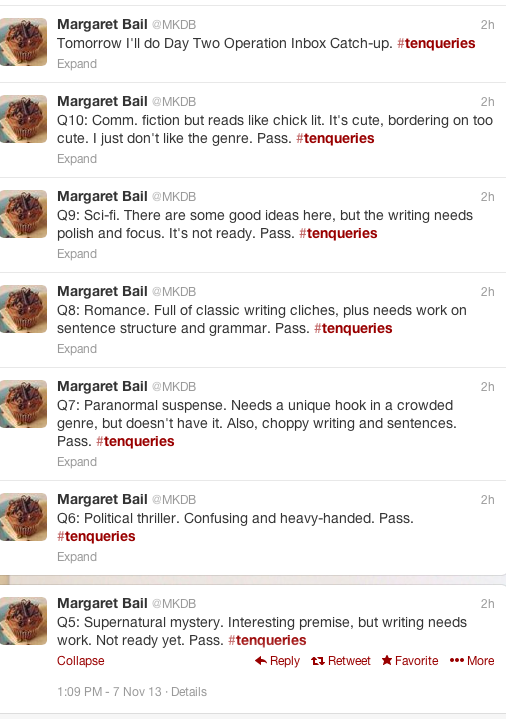
 November 8, 2013
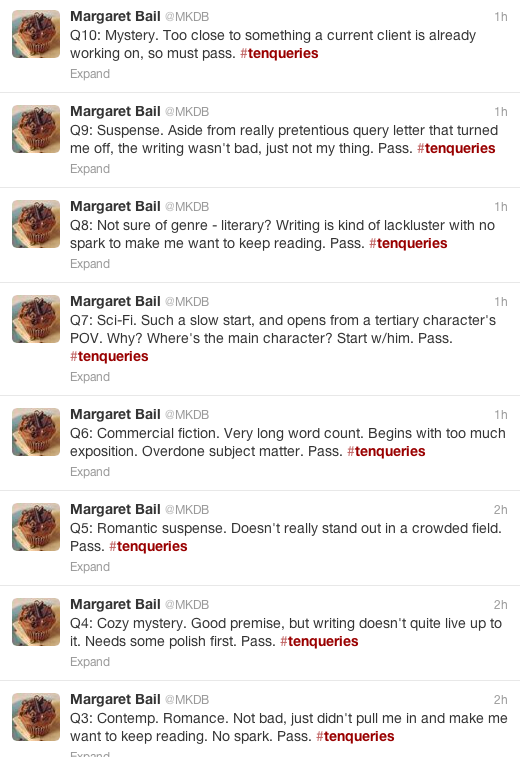

This agent read 20 queries and requested two. The odds are slim but you can increase your odds by writing a great query and following the submission guidelines the agent has posted.
Now, go write and rewrite. I hope you get to do the happy dance soon.


 alvaradofrazier.com