Faith, Travel

Wishes in Budapest

The third leg of my trip was to the cities of Buda and Pest. Both are enchanting by night, on a dinner cruise up and down the Danube. But instead of describing the sites, I’m going to tell you about one statue in the city park.

Up until now, I have been an ‘anonymous’ poster, meaning there is no ‘real’ photo of me on this site. Until now. And it’s all because of Mr. Anonymous, a real person, or statue, I met near the Vajdahunyad Castle. The castle is a copy of one in Transylvania, Romania. Why, I don’t know.

Mr. A. is kind of a spooky looking character, as portrayed by the artist, and it’s fitting that he sits near an equally spooky looking castle. Until this day we don’t have a confirmation of who this gentleman was but it has been narrowed down to an Italian or French immigrant who served in King Bela’s court, in the late 1100’s.  The inscription beneath the sculpture reads: “The Anonymous Notary of King Bela.” There were a couple of King Bela’s so that confuses the issue. This notary, or chancellor, wrote a historical manuscript of Hungary, full of early Hungarian history, legends, and politics of the day. Now we know why he chose to remain ‘anonymous.’

In the photo you will note that his pen is burnished to a bright golden color. Hungarian folklore says that if you touch the pen you will gain inspiration for your writing. I had used every opportunity to make wishes on the Charles Bridge in Prague, there were no opportunities in Vienna unless I count all the wishes I made when I entered the Swarvoski store, so I touched the pen.  Actually, I rubbed it before the photo was snapped.

Have I had inspiration to write? I’ve written a few pages and completed a couple of blog entries in the past 3 days, but that’s been the usual routine for the past four months.  And I did make a complete rewrite of my first chapter, trying out 1st person instead of 3rd person point of view.

But what I really wanted was a burst of inspiration that would push me through to a spectacular ending of my second manuscript. Why didn’t I think of those exact words when I was touching the pen? Probably because I was trying to stand up straight and keep my eyes open for the camera. Instead, here I am ‘outing’ myself in a tourist photo and becoming ‘un-anonymous,’ for the sake of this blog.
Boycotts, Cesar Chavez, Chingonas, Faith, Family, Strong Women, Wisdom

Remembering Cesar Chavez and My Mom


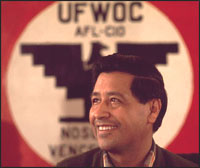
I love this photo. The black Aztec eagle symbolizing la causa is so familiar. Every time I see it I not only think of Cesar Chavez, but also of  my mother. I was in grammar school the first time I heard of boycotts, farmworker rights, and la causa. My mom was in night school at Ventura College and went to community meetings at the CSO building. 

One weekend she packed her bags and took off to Delano with several of her younger classmates and community organizers to participate in a march. When she came back she talked with a fervor about Cesar Chavez and farmworker rights. “Did you know he lived in Oxnard? Right here in La Colonia.”  His speeches moved her, she could relate, she embraced his words of “Si se puede.”

Mom was a migrant worker from the time she was a toddler playing  under the sombra of the vineyards until she was fifteen and cutting her hands on the thorny brambles of the cotton bushes, moving from place to place first with her parents, then with her tios when they both died. She hated that her education was interrupted and for that she never wanted to work in the fields again.

Her participation in la causa and community meetings were fodder for several arguments with my uncles. “What the hell are you doing, going to these meetings, isn’t it bad enough you go to night school, you’re never with your kids…”

That rang true, but she wasn’t gone because she was in a bar or with some man, we kids knew that. No one talked stuff about our mom like they did about one of the moms down the street. But sometimes she crumpled under their barrage of words, other times she let loose on them. Whatever happened though, my uncles and their wives were there for us, lending Mom money, bringing us food, and taking care of us.

Years later, when I was in high school we had renewed arguments, this time both my mom and I harangued our relatives. “We’re boycotting Coors, switch beers,” we’d say whenever they visited. “We thought it was just grapes,” they’d yell and add, ‘que la chingada,‘ for emphasis. It took a year of confronting them every time they popped open a Coors, but they stopped buying the brand.

In college I remember boycotting Safeway, standing in picket lines in Santa Barbara, and waving that red flag. By this time my cousin was involved in the Brown Berets and my mom was busy marching for a community pool in La Colonia, addressing workplace issues, and working on her BA at a university. My uncles noted the photos of the Kennedy’s, Cesar Chavez, and the Pope on the walls of our home. ” Is this is why you go to college?”

When Cesar Chavez died Mom went to Delano and paid her respects with 50,000 other people and mourned the loss of the great man who inspired her and gave her the three words she often repeats whenever we get discouraged. 

“Si se puedes,” she says, yes you can. And when I see that iconic flag, I hear those words, remember those sacrifices, and think of Cesar Chavez and my mom.