An Unquenchable Thirst, Faith, Mary Johnson, Memoir, Mother Teresa, Roman Catholics, Strong Women

Review: An Unquenchable Thirst


One of my all time pleasures is reading. Lots of books, usually two or three at the same time. I’ve been called a bookworm, bookhound, and bibliophile. 

I would call myself a bookinista-you know like fashionista. But I thought of a Spanglish term, a hybrid of “book,” and “conquista,” hence booquista, or book conqueror. 

I read to momentarily escape from my world, learn about other cultures, societies, or to see things from another point of view. 

Last month I had the pleasure of hearing Mary Johnson read selections from her book AN UNQUENCHABLE THIRST: A Memoir, at Vroman’s Bookstore in Pasadena. 
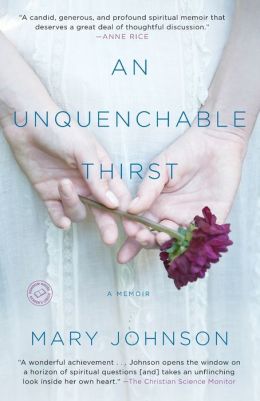
I wanted to read this book because I was born and raised a Catholic during the 60’s/70’s. I attended Catholic elementary and high school. When I was around nine years old, I contemplated becoming a nun. That went out the door when I turned twelve.

I was also curious about Mother Teresa and her missionary nuns. The curiosity about cloistered life was a big draw. 

When I was a kid I thought all nuns were like my grammar school principal, Sister John Bosco, who carried a yardstick with her at all times and was OCD about clean chalkboards. 

I never thought about how nuns dealt with their humanness or feelings of sexuality, until Sister Rose Marie ran away with Brother Peter, the Dean of Boys at my high school.


But back to the book. At seventeen, Mary felt a calling when she saw a photo of Mother Teresa on the cover of Time magazine-18 months later (Summer of 1977) she began training as a Missionary of Charity, a nun in Mother Teresa’s order. 

The story has been described as a spiritual memoir and a feminist coming of age memoir.

Mary recounts her experiences as a teenager, young adult, and mature woman facing the challenges of living an austere life of poverty, chastity, and service. It takes a strong woman to serve under those conditions, ones she freely took, but persevered. After 20 years of service she leaves the Catholic Church to find her own path. It takes a strong woman to leave when your convictions guide you to do so. 

This is not “The Singing Nun,” or just a diary of a woman in a religious community. Her story goes deeper, into the culture of this particular order and her responses to her experiences. This is about her own spiritual development, faltering, doubt, hope and faith. 

You may have heard that the book has been calledanti-Catholic,’ negative, shocking.  

I didn’t see it as anti-Catholic. It was Mary Johnson’s experiences with pre-Vatican II dogma that she questioned. Heck (you know I wanted to say He**, but I still remember the yardstick). I questioned that a lot too, doesn’t make me anti-Catholic. 

Yes there are some experiences that surprised me (falling in love, stalked by a sexual predator subordinate, self-flagellation). But these are precisely the things that show the woman behind the blue and white sari. She speaks of these issues with candor and empathy, not as melodrama. 

The memoir reads as a novel, it’s intimate, descriptive, and intriguing. The insights into the political ‘party’ of Rome, the interactions with the other nuns and the townspeople they served, and the insider knowledge of Mother Teresa herself was very engaging. 

If you love reading well written insightful memoirs that give you a peek into other societies you will find this book enthralling. 

Sincerely,


Author Sonia Sotomayor, Book Review, Books, first Latina Supreme Court Justice, Latino culture, life lessons, Memoir, My Beloved World, Strength, Strong Women, Wisdom

Lessons from Sonia Sotomayor: My Beloved World

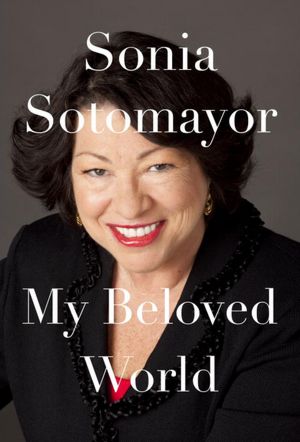
The Honorable Chief Justice Sonia Sotomayor has been on several television programs this last month and it’s not for any Supreme Court hearing. It’s because of her memoir, “My Beloved World,” which has garnered much praise and is the Amazon Book of the Month for January 2013. 

Much of the attention to the book may be because she is the first Latina Chief Justice and the third woman appointed to the Supreme Court. That’s certainly a draw, but not the only reason I selected her memoir to read. 

I was drawn to order the book because I knew there had to be a story of a struggle, tenacity, and spirit in her story. 

Someone doesn’t become the first Latina or  a woman judge, CEO, astronaut, or any other distinguishable career choice without more than a few bumps in the road. I was interested in reading about the journey on that bumpy road from the slums to the Supreme Court.

Like many readers, the stories that resonate with me are about people who suffer a loss, endure hardships, and rise to survive and thrive with courage and strength. This memoir certainly fit this description.

Ms. Sotomayor’s candid memoir concentrates on her childhood, college years, and life before she became a federal judge in 1992 and Supreme Court Justice in 2007. 

I found the first half of the book, about her childhood and teen years, the most engaging. A few life lessons stood out which made the lengthy book a pleasure to read. 


Lessons:

  1. Self reliance.

Her diabetes required insulin shots several times a day,(in an era without disposable syringes). Her father, an alcoholic, couldn’t be relied upon and her mother was overburdened. “To my family the disease was a deadly curse…my parents couldn’t pick up a syringe without panicking…” So she learned how to do this herself at age eight.

   2. Value family and culture.

Her Abuelita was a huge presence in her life, as well as her aunts, uncles and cousins. She often returned to Puerto Rico to visit relatives. Her grandmothers family parties always featured Puerto Rican dishes, Spanish music, and poetry.

She took numerous classes to learn more about Puerto Rico and even wrote her thesis about it. In her dedication she wrote, “To my family, for you have given me my Puerto Rican-ness.”

   3. Do your best and then try harder.

Education was important to her mother, who worked extra shifts to place her in Catholic school. “Discipline was what made Catholic school a good investment in my mothers eyes…discipline was virtually an eighth sacrament.”

   4. Expand your horizons.

Books were Ms. Sotomayor’s introduction into another world. The summer after her father’s death, nine year old Sonia spent everyday in the public library reading the stories of Greek gods and heroes. Her mother bought the Encyclopedia Britannica (as did my own mother) from a door to door salesman. “I found myself wandering the world’s geography, pondering molecules like daisy chains…the world branched our before me in a thousand directions…” 

Not every effort to  expand her horizons were as welcome as books. “Ballet class was a brief torture…Piano wasn’t much better…Guitar lessons…the worst of all. The real problem was getting there and back through a neighborhood..where a gang of taunting bullies made clear Puerto Rican kids were not welcome. I got smacked…”

    5. Find role models.

Television doesn’t usually bring to mind role models, but for Ms. Sotomayor Perry Mason, the defense attorney and Burger, the prosecuting attorney were her heroes. “…I liked that he was a good loser, that he was more committed to finding the truth than to winning his case.” She paid more attention to the judge on the show. “…it was the judge who fascinated me. A minimal, but vital presence,…a personification of justice…it was the judge who called the shots.”

Her mother, who returned to school after her husbands death to become a nurse, taught her “…a surplus of effort could overcome a deficit of confidence.”


   6. Seek to understand.

Poverty, her fathers alcoholism, her mother’s emotional detachment, racism and divorce played a part in her early life, but the reader finds that Ms. Sotomayor seeks to understand others instead of being a judge (no pun intended). 

Besides the tough childhood, strenuous college and beginning years in law, the Chief Justice also divulges that she enjoys parties, asks for hugs, was a three and a half pack a day smoker, and is a “pretty good poker player… I do win regularly among my friends. I don’t think they let me win.”  

It is no wonder that Ms. Sotomayor has this plaque on her office door:


The plaque says it all, but read the book to see how she made history.