November first begins the Day of the Dead (Dia de los Muertos) festivities and whose roots can be traced back to indigenous cultures. The Aztecs had a celebration in the ninth month of their calendar with a celebration to their goddess Mictecacihuatl, the Queen or “Lady of the Dead.”
Souls did not die, they rested in Mictlan. Her role is to keep watch over the bones of the dead and she presided over the ancient festivals for the departed. She and her husband, the King of Mictlan, were depicted as skeletons and lived in an underworld of bats, spiders and owls.
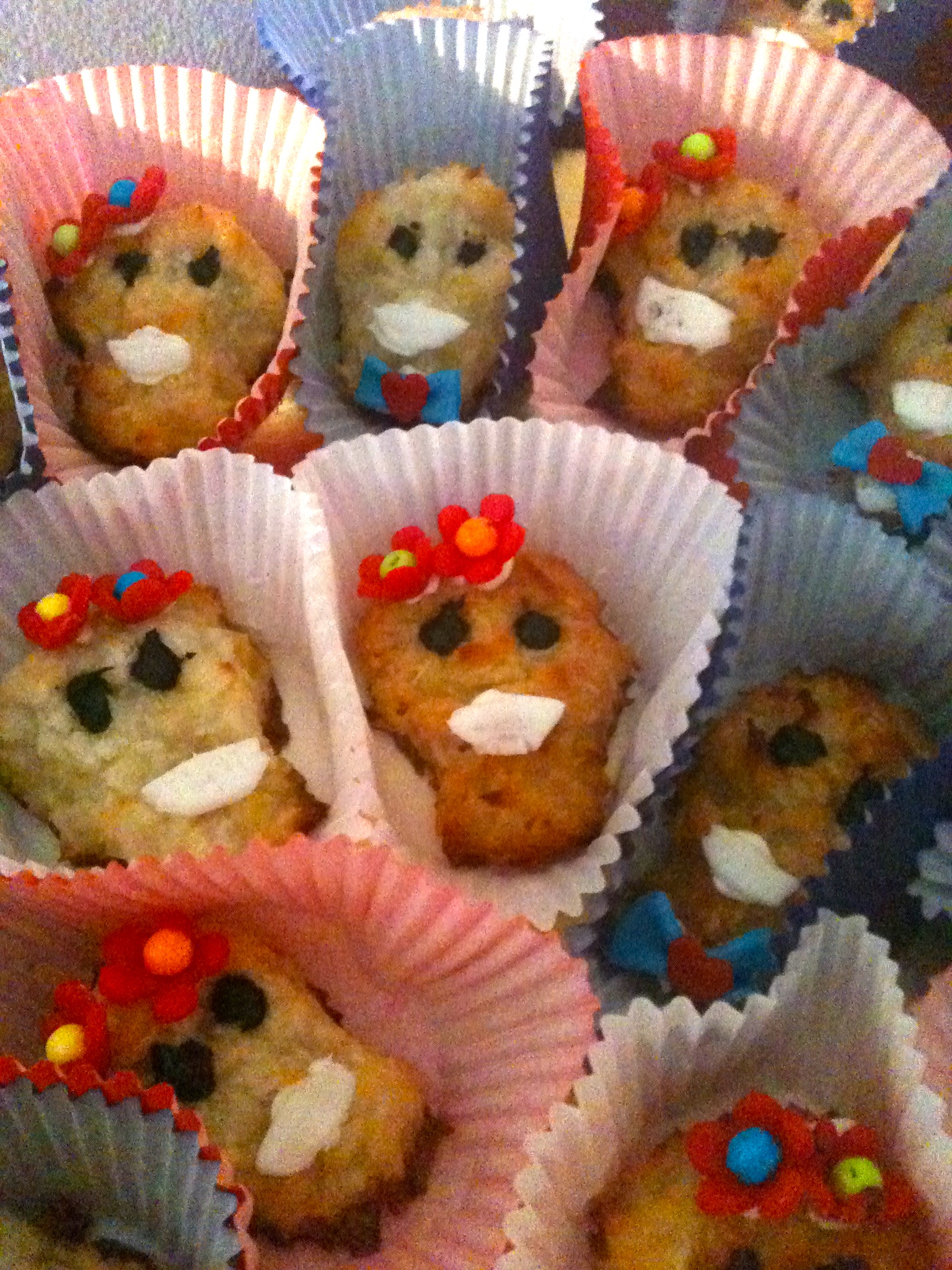
The calavera, or skeleton is an icon of the DDLM. It has now evolved to stylized and colorful versions of the skull or skeleton figures. You’ve probably seen hundreds. You can find the history of the sugar skulls here. Many times you’ll see skull shaped breads, cookies or candy. I had these delicious cookies last year:
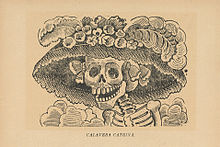
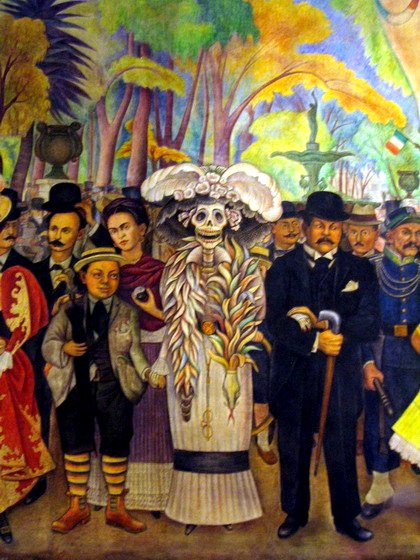
Another icon of DDLM is La Catarina. She is originally found in a 1910 zinc etching by Jose G. Posada, Mexican printer maker and cartoonist. Later La Catrina was stylized as a female skeleton dressed in a hat befitting the upper class outfit of a European of her time. Her hat originally is related to French and European styles of the early 20th century. She is meant to portray a satirization of those Mexican natives who the artist, Jose Posada, felt were over embracing European traditions of the aristocracy in the pre-revolutionary era.
DIego Rivera’s “portrait” of Catarina popularized her in this 1946 mural.
The Kid-Diego Rivera. Wiki Creative Commons Lic.
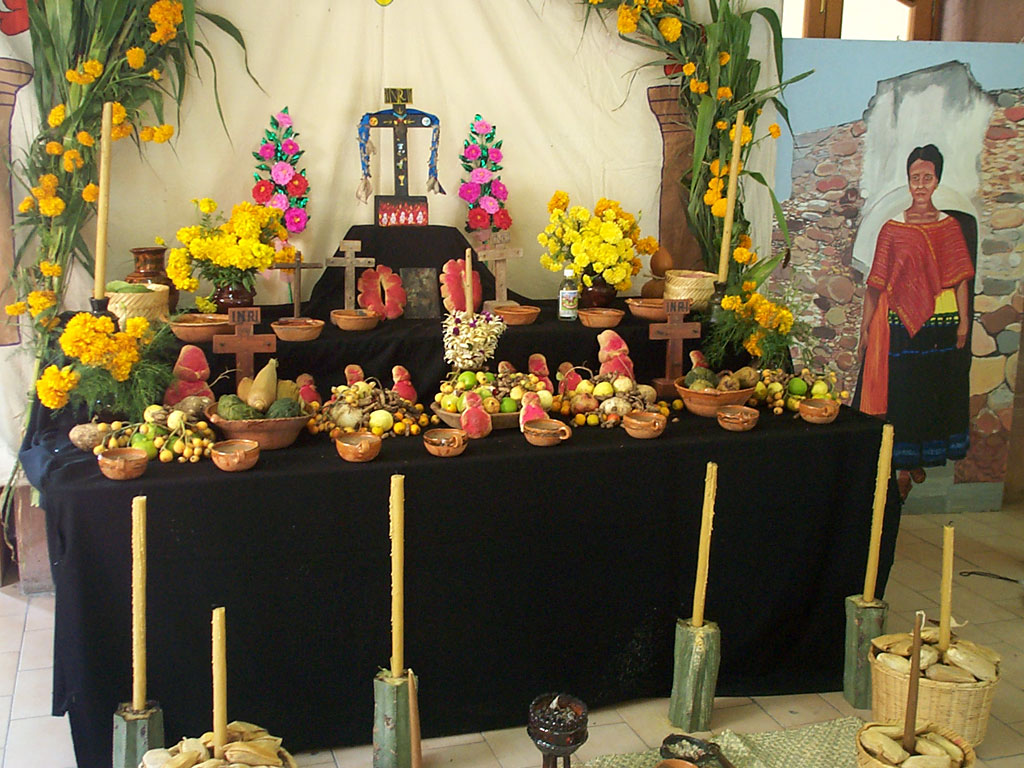
The spirits of the deceased are thought to pay a visit to their families during DoD and the families prepare an altar, another icon, for them. The altar is used to hold offerings, or ofrendas, for the departed. Their favorite foods, photos, and mementos are often placed on the altar together with items the deceased enjoyed: toys, candy, liquor, hobbies, etc. A bar of soap, towel, bowl of water and other grooming items are traditionally left at the altar with the belief that the dead have been on a long journey and would like to refresh themselves.
Day of the Dead Altar-Mexico, Wiki Images
An icon that celebrates the indigenous roots are the Four Elements: wind, water, earth and fire are often represented on the altar. Wind is sometimes signified by papel picado that moves in the breeze. Candles depict fire, food represents earth, and liquids represent water. The cempasuchitl (Mexican Marigold) is an Aztec tradition, and another icon, which says that the twenty-petal flower attracts souls to the altars.
In the last ten years, Day of the Dead celebrations include both traditional and political elements, such as altars to honor the victims of the Iraq War. There are updated, inter-cultural versions of the Day of the Dead such as the event at the Hollywood Forever Cemetery, (a very cool website). This year the Smithsonian Institute has a celebration-on 3D!
Smithsonian Institute Dia De Los Muertos
The DDLM’s has become more widely known and accepted. Although I didn’t grow up with DDLM’s, I did grow up with small altars in our home, where we did have statues and prayed for the departed throughout the year. This was more in the tradition of Catholicism.
This year, like the last three years, I’m attending a DDLM party at the Ventura County Museum, which features crafts, altars, drinks and dancing. Whichever way you honor your loved ones and those who have departed, may you have a memorable Dia de los Muertos.
It was at the AROHO retreat when words began to jam the inside of my head, seeking the way out, like never before. I wrote my first poem while I was in a workshop with Jillian Lauren , who taught “Writing on the Edge.” Two days later I had two more poems. I thought in verse without knowing or trying.
Maybe it was the gorgeous landscape around me, coupled with the synergy of wise wonderful women (bien Chingonas) attending the retreat, or maybe it was the spirit of Ghost Ranch and the motto of New Mexico: “The Land of Enchantment.”
Since returning from New Mexico, five weeks ago, six more poems have leaked out of me. The one below came to me in the middle of the night, a few days after I returned from AROHO. My critique group, Women Who Write, helped me form the poem into something a little more coherent.
The original name of the poem was Braids, but today, in honor of National Poetry Day and NPMonth, I retitled it to post on a blog I happened to stumble upon, Poetic Bloomings. The task was to write a poem about composing a poem. The prize is a book of poetry (and you know I love free books).
Poems
Braid words
to reach across
expanse of experiences
Pull together strands
of pain, joy
sadness, hope,
wisdom, love
bit by bit, strand by strand
Form strength
tighter, stronger, thicker
criss cross
hand over hand
fingers nimble
fast, slow
Pull together
thick cords
ropes of strength
Sycamore trees, Oxnard, CA
On my walk yesterday, I came upon a Sycamore, usually the only trees in the whole neighbor and my coastal city, which give evidence that autumn has arrived. Among the palm trees and drought resistant plants, the Sycamores stand out in their demise, brilliantly. A red leaf dropped in front of me and ‘walked’ like a starfish across my path.




 alvaradofrazier.com