Writing, writing conferences, writing tips

Lessons Learned at the WD Conference


Two words for the Writer’s Digest Novel Conference in L.A: Worth It!

A couple of weeks of craft workshops jammed into two and a half days may be overwhelming, but there was lots of value for $249.

Twenty plus pages of facts, thoughts, post-its to self, and business cards fill my note book so this will be a two parter.

I’ll start at the beginning and give some highlights. All of the speakers have websites and resources you can find through the links I’ve listed.

Keynote quote speaker Jonathan Maberry spoke on importance of being a good literary citizen,

“don’t be a jackass,”

“any completed first draft is a win even if it’s bad because you completed it.” 

1. An Intro to Structure That Empowers Plotters and Pantsers Alike and Your Story on Steroids- Larry Brooks, Storyfix.com gave us slam dunk specifics. There are too many notes to give here, but go to his site for the free downloads. A gem for me was:

“Know the difference between concept and premise. Develop these before writing the story.”

Believe me, I’m a pantser, now in recovery, and this tip helps tremendously:

“Concept: the dramatic landscape of story that is conceptual; the stage, or arena. No character names needed. Write this in two or three sentences.

Premise: the protagonist has to have a conflict to surmount, a quest. Define your story core.”

2-Your First 50 Pages – Jeff Gerke. This author/editor is the Jim Carrey of the writing world who talked about how neuroscience relates to storytelling.

“In publishing everything is decided on your first 50 pages-if even that.”

Writing has to cause the reader to identify with someone/something in the story. Make the protagonist vulnerable or have some kind of need. Engage the readers mind with action, intrigue, curiosity. The brain is looking for danger, surprise, something new, so start with that in the beginning.

Martha Alderson, Plot Whisperer with her graph

3. Martha Alderson, the Plot Whisper. She uses a plot graph to show you how to correspond your novel with the beginning, middle, and end of a plot.

There are four types of scenes: suspense, dialogue, crisis, and twister.

Catch her detailed mini-workshops on YouTube where she shows you how to plot a novel or screenplay.

Every scene should have a setting…goal…sensory details…forward movement…opposition.. and emotion.

There is a difference between the crisis and the climax of a novel:

Crisis-the antagonist wins, protagonist loses. Climax-protagonist wins and learns everything in the middle.

4. Ask the Agent Panel. A list of pet peeves and suggestions:

Misspelled names…using the words ‘fiction novel,’ bad grammar, writers who don’t read the submission rules,…pitching at inappropriate times. 

As if on cue, when the Q & A period began, a woman pitched her book, “Anyone interested in….” Ugh, it wasn’t pretty.

Search for agents by using Query Tracker, Twitters #MSWL (manuscript wish list), or go to the bookstore, look for books in your genre and on the last page under acknowledgements, the agents name is usually listed. I use Poet and Writers agent listing.

One of the agents said she was looking for a YA set in prison. It was like the heavens opened up when I heard this statement. I had to make myself stop wiggling in my seat and wait for a time when I could tell her I had such a novel. During Q & A I said I had the novel she wanted,  she said send it to me.

Then  I asked a question: whether more emphasis was placed  on the query or the first 10 pages. Two out of three agents said the first pages.

I need 50 pages to know if a book is good, but only 1 to know it’s not.”


I hope you found something useful for your writing life. Investigate the presenters sites. Plan to attend a conference on writing craft. Invest in your writing.

If you have a specific question that I may provide information for, please ask me in the comment section.
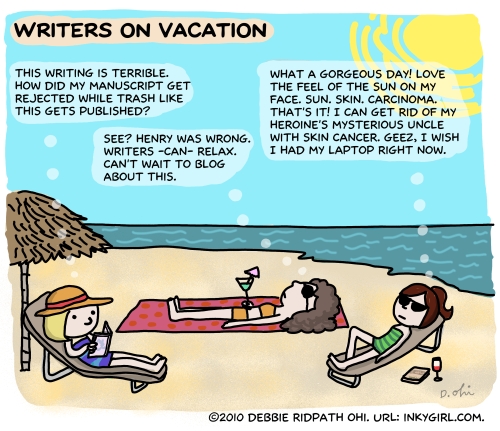


Encouragement, Strong Women, Writing

Agent: What I Wish Writer’s Knew

"Used with permission from Debbie Ridpath Ohi at Inkygirl.com."
“Used with permission from Debbie Ridpath Ohi at Inkygirl.com.”

After a short birthday break in beautiful San Diego, California, I’m back to my writer’s world, feeling a little down.

Like many writers one gets discouraged after a couple of years or five. I’m most happy when I’m writing stories, following the character on a journey, ending up in places I hadn’t intended. I have to confess that I like revision too. At least I’m still with my characters, in the story.

Right now I’m in the close to blah place: sending out queries, reading rejection letters and submitting poetry and short pieces to small journals.

What perks me up is blogging. I can write, post, maybe a few readers or fellow writers like the subject, and I feel a connection to the comments. Someone hears me, someone is talking with me. It feels like community. This helps motivate me to keep on keeping on.

Today, I want to continue with what I learned at the A Room of Her Own (AROHO) writer’s retreat last month.

Agents. Ack! FInding one is like searching for the Holy Grail. They don’t drop out of the sky or come knocking at your door. A writer hopes their query letter grabs and holds them until they finish reading the darn letter, jot down your name, and call you. It could happen. Or not.

Truth is Literary Agents are working people. They have to make a living. If they take a gamble on a writer, the odds better be in their favor.

I’ve noticed that in the last three years, conferences invite Agents and writers to participate in an Agent/Writer speed dating event. The writer has 90 seconds to 3 minutes to make their pitch before the bell rings and the writer moves on. Nerve-wracking, mind boggling, exhausting (but that’s just my opinion).

Speed dating. Gettyimages.com

Here’s what this agent participant had to say about Speed-dating for Agents.

For those of you who don’t chose to pay and involve yourself with the speed dating scene (at least for now), here’s some advice and wisdom from an agent I had the pleasure to hear speak at AROHO 2013.

Joy Harris established the  Harris Literary Agency. She is most interested in literary fiction and narrative non-fiction. Her interest is in working directly with writers to help guide their careers, negotiate on their behalf, and protect their work. At the AROHO retreat she presented a short workshop on

“What I Wish Writer’s Knew.”

  1. “Who is going to read my book.” Writers should have a good idea of their audience. Tip: “Everyone,” is not the answer. Think age range, educational level, personal or professional,  and interests. Communicate this to an agent.
  2.  Your MS has to excite the agent, right away from that first sentence of the first paragraph. Editors and Agents have less time and the pile of manuscripts (MS) is higher.
  3. Find avenues to get your shorter works published. Research journals and small presses. Get your work out there. (I subscribe to Poets and Writers magazine and they have an online search for writing contests and journals).
  4. Approach an Agent Appropriately. Find out which agents represent books in your genre. Read the submission rules and follow them. Keep your query letter short-one page. Be prepared to make your pitch short and sweet. (Rachelle Gardner has a fill in the blank pitch).
  5. Short stories and memoirs are not selling as well as before, but are much easier to publish if the short stories/memoir is your second or third book.
  6. Self-publishing and E-Book publishing are difficult. Be prepared to be the agent, writer, publisher and marketer.
  7. Publishers want writers with a platform whether it is celebrity, social media, or professional connections.
  8. Publishers want writers to have publishing credits: work in journals, magazines, awards, contest winners or honorable mentions.
  9. Contracts: Don’t sign a contract that ties you to an agent for “…all future works.” It should have a 30 day notice of termination.

Bottom line is there is no easy road to publishing, but we can prepare ourselves with up-to-date maps, rest stops, and visits along the way to make the cross country journey a little easier.

Inner strength, patience, humor, and community helps. So does coffee, dark chocolate and good wine.