Blog

Family, Latino culture, Latino Family Traditions, Mexican traditions, Parenting

The Importance of Cultural Traditions

At the Baptismal Font

This past Sunday my family and I attended a celebration that stirred memories of our young adult lives and childhood. We attended a “Bautismo” or baptism. It is one of the seven religious sacraments of the Catholic Church where an infant is initiated into the spiritual community of the Church.

It has been many moons since our own children were babies and now that several of our extended family are not Catholic (except for my mother) we don’t attend baptism’s as often as we did in our childhood and young adulthood.

Cultural traditions remind us of who we are and where we came from. That is why we were delighted that the young couple, college graduates, third generation Mexican American’s, followed the traditions of their culture and religion.

Mexican and Mexican American baptisms have their own baptism rituals. The parents select godparents, or compadres, who traditionally have the duty of raising the child if the child’s parents were to die. This isn’t a legally binding contract, but more of a moral obligation or promise to bring up the child as a Catholic.

After the pouring of the water on the baby’s head, the priest invites the parents to light a candle from the main candle at the altar. Prayers are said, the blessing of the oil takes place, and then the baby, parents and godparents are presented to the congregation.

The next ritual is the throwing of bolos. When we were children we lived in a predominately Mexican neighborhood, so bautismo’s and the ritual of the compadres throwing bolo was frequent. This is a gift of coins thrown to all the children attending the baptism. Bolo is said to symbolize prosperity and good luck for the infant.

photographer R. Ambriz
Photographer R. Ambriz, muralized

Usually bolo was done on the steps of the church after the baptism ceremony. Pennies, nickels and dimes rained upon the heads of children scrambling for coins. In those days you could buy nickel candy bars, so bolo was quite the event. You could imagine that children from all over, and some adults, frequented the church steps on Sunday late afternoons after baptism ceremonies. In our neighborhood, everyone knew that twenty something Petra, would be at every baptism. She was mentally disabled so she was given a pass. But now bolo is thrown at the reception party.

A party takes place after the baptism, usually a backyard barbecue, for the family and friends of the parents. This is an opportunity for the extended family to get together and bring each other up to date. For us, the ‘old parents’ it was a time to reminisce about the baptismal parties we threw, how the years fly by, and how glad we are that the traditions we grew up with have not died out.


Chingonas, Encouragement, Writing

Writing a Query Letter Sucks Sometimes

Getting to the gate
Getting to the gate

Ugh writing query letters suck. They are a necessity for the unpublished writer without an agent. Writing a good query is not for the faint of heart, you have to be in it for the long haul, you have to put on your big girl chones (panties) or big boy pants to write, rewrite, a few times. It takes a chingona to re-work a query and not give up.

You can moan and groan or look at the query letter as an adventure-with turbulence. The query letter is your calling card, your advertisement for your unborn baby (book) that you have worked on for months and years. The query letter is your ticket to the “Gatekeeper” who can unlock the giant fence that leads to another huge gate “Publisher.”

Writing the query letter doesn’t have to suck too much if you get a format down, work hard

at revising it after a critique, and follow the advice of literary agents who read query letters for a living.There are tons of articles on how to write a query letter.  

A search for “How to write a query letter ” yields about 3,560,000 results in 0.22 seconds.

It is very hard work assembling your story into a calling card that makes an agent say “I gotta have this manuscript…”

You only have one page, three or four paragraphs that have to seize the agent’s attention and keep him/her reading for more than 10 seconds.

Your query has to grab and hold that agent, make her nod her head and say, “This is promising…” Your query has to have her type “I’m interested…send me your full manuscript.”

When you get a request for full you do the “OMG” gasp, reread the email, do the happy dance, mouth a prayer of thanks, light a candle

and ask your friends to send their positive vibes, energy, and prayers into the universe for you.

Or maybe that’s just me.

happy dance
happy dance

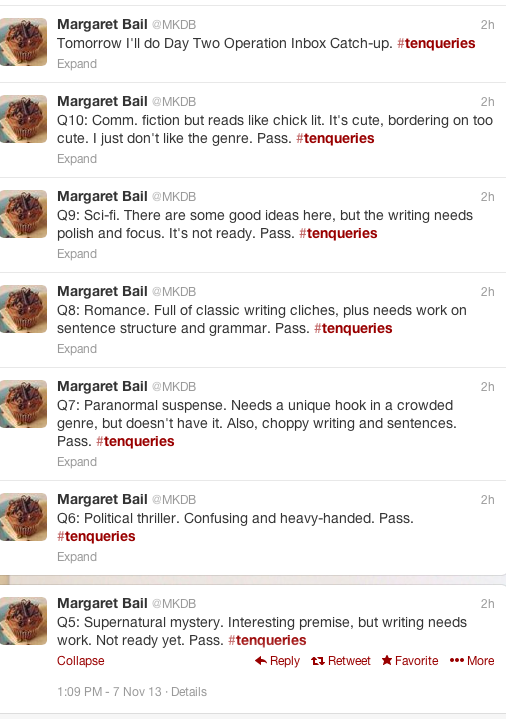
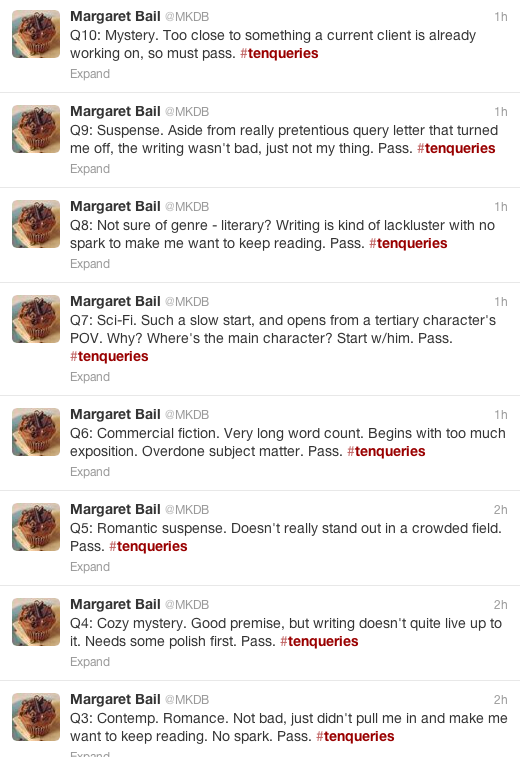
Here are two formats I used when writing my query letters. At the end of the post I’ve copied a Twitter feed from the cool agents who are on Twitter’s #tenqueries. You can learn a lot from the rejection/pass stack. 

The first formula for a query is from Nathan Bransford’s blog:

[Agent name], [genre], [personalized tidbit about agent], [title], [word count], [protagonist name], [description of protagonist], [setting], [complicating incident], [verb], [villain], [protagonist’s quest], [protagonist’s goal], [author’s credits (optional)], [your name]

Now, look how your query turns out:

Dear [Agent name], I chose to submit to you because of your wonderful taste in [genre], and because you [personalized tidbit about agent]. [protagonist name] is a [description of protagonist] living in [setting]. But when [complicating incident], [protagonist name] must [protagonist’s quest] and [verb] [villain] in order to [protagonist’s goal]. [title] is a [word count] work of [genre]. I am the author of [author’s credits (optional)], and this is my first novel. Thank you for your time, and I look forward to hearing from you soon. Best wishes, [your name]

Another formula is from Agent Query: 

  1. Paragraph One—The Hook: A hook is a concise, one-sentence tagline for your book. It’s meant to hook your reader’s interest, and wind them in.
  2. Paragraph Two—Mini-synopsis: This is where you get to distill your entire 300 page novel into one paragraph: (approx. 150 words).
  3. Paragraph Three—Writer’s bio keep it short and related to writing.
  4. Your Closing: As a formal closing, be sure to do two things. First, thank the agent for her time and consideration. Only send what the submission guidelines specify.

The hashtag #tenqueries is for an agent  who goes through his or her query inbox and shares the reasons why they do or do not request a manuscript. This is the post from November 7, 2013. Read from bottom to the top: Screen Shot 2013-11-07 at 4.05.11 PM Screen Shot 2013-11-07 at 4.06.48 PM November 8, 2013 Screen Shot 2013-11-08 at 2.19.52 PM Screen Shot 2013-11-08 at 2.20.25 PM Screen Shot 2013-11-08 at 2.22.21 PM

This agent read 20 queries and requested two. The odds are slim but you can increase your odds by writing a great query and following the submission guidelines the agent has posted.

Now, go write and rewrite.  I hope you get to do the happy dance soon.