Blog

Family, Parenting

How I Found Happy Family Memories in a Token

French solider mask, cinco de mayo parade
A Real Cinco de Mayo Parade, photo by Kym Janisch, creative commons


I was going to write about the commercialization of Cinco de Mayo and how much I disliked the marketing of a cultural holiday that symbolizes the hope and pride of a people. About how much I hate to see “Drinko De Mayo,” and “Nacho Ordinary Cinco,” slogans. The distaste for ads featuring tacos and sombreros.

The post for this week was preempted by memories that had me travel many years back. So I changed my mind. But, if you’d like to read about what Cinco de Mayo really means and the French invasion of Mexico, I have an old post here. There are several posts about Cinco de Mayo. I like the one given by the History Channel.

The idea of a Cinco de Mayo post came to an end when I cleaned out my desk drawer hunting for an emery board. Underneath ink pens, rubber bands, post-its and an old address book, I found some foreign money. Coins representing four countries and two Chuck E. Cheese tokens. So make that five countries. Thus began my time travel.
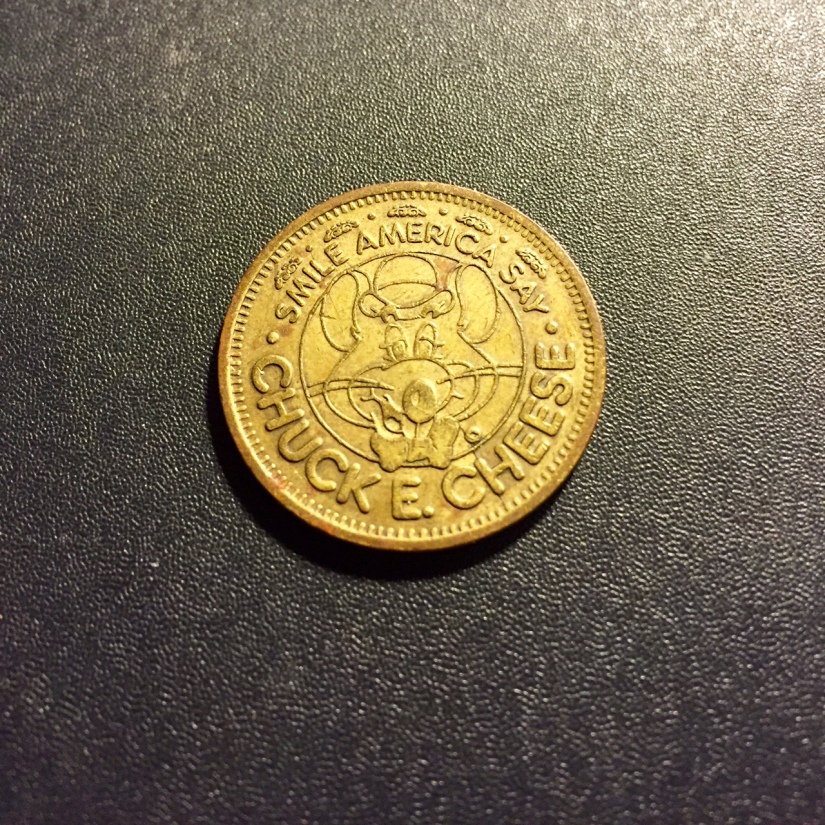
token
Chuck E. Cheese token, circa 1993. “Smile America Say”


The faded image on the fake bronze coin showed a big nosed rat in bowtie and bowler hat, circa 1993. Why the weird phrase  “Smile America Say,” is engraved on it is a mystery to me. The other token had a different saying, but I lost that one between last night and this morning.

The rat took me back to the colorful sights and chaotic sounds of our local Chuck E. Cheese restaurant, “Where a Kid Can Be A Kid.”

All three of my children celebrated birthdays at the place among shrieking delighted kids and parents who moaned at the noise level and overpriced bland cheese pizzas.

Chuck E. Cheese parties for the kids in our extended family was a rite of passage, for the children, moms, and dads. We entered the fun zone as proud parents holding onto the small hands of excited birthday boys or girls and left as frazzled shell-shocked adults, sometimes forgetting one of the kids until halfway down the freeway, (she knows who she is).

Kids ran to dive into the orange, yellow and green balls, disappear into fluorescent plastic tunnels, while parents covered their eyes and ears from the blinking lights, electronic noises, and shrieks. Some of which probably came from the parents who’d been in the place for half an hour.

Try keeping track of your kid in the crowd of pint-sized children all waving arms, jumping, twirling, or cowering in a corner. (Wait, the cowering would be at the parent table).

All that excitement doubled when the red curtain rose and the mechanical singing chicken, mustachioed chef, and the blue guy who appeared. The smarmy dancing and squawking of the robotic characters, behind the arm-waving teenage CEC workers, delighted the under six-year-old set whose parents tried to look semi-excited but came off as confused, scared or both.

confused parents
Confused or Scared? flickr.com creative commons photo

When the bottom heavy rat strode into the melee of children I thought he looked like a thug rat in a knockoff Mickey Mouse film. But the kids, especially my toddler daughter hugged the seven-foot gangster rat like he was her cuddly stuffed lamb. Her eyes and body danced to the songs of the chickens, while one son veered away from Mr. Chuck E. Cheese and the noise, concentrating on a birthday cake and waving balloons. The older son ran circles around the rat and scampered back to the game zone, clutching trailing strips of orange tickets.

Ah yes, the memories. Happy and frightening at the same time. All those germ infested rainbow balls, tickets and tokens, bland pizzas and a giant rat returned to me via a grubby Chuck E. Cheese token.

Maybe I should have stuck with a Cinco de Mayo post.

Encouragement, Writers, Writing, writing tips

The Dangers of the Helicopter #Writer

golf balls with letters
WRITER-Photo by Dave Morrison, flickr.com, cc


I’m writing a story about a twenty-one-year-old young woman. In the midst of writing it, I think damn she’s making a lot of mistakes and I begin to edit some of the stuff out until it dawns on me the character is twenty-one.

I have this ‘thing,’ in my writing, I’ll admit it.  I try to protect my main character.

This happens in the first draft. When I re-read the chapter, I realize I’ve made worse mistakes than the character I’m writing about and I lived another day.

I’ve been soft on the main character. I haven’t pushed her. 

So I have to quit the coddling the protagonist because I’m being a helicopter writer. (Same as helicopter parent but with an imaginary child). And that never turns out well.

typewriter, pen, journal, paper
The Dangers Of The Helicopter Writer – Photo by Dustin Lee, unsplash.com cc

From my own experience, here are some of the signs of a hovering writer:

  1. Boring writing: The writer is afraid to look beyond and beneath the surface. They are afraid to dig and go deeper into the mind of the main character. What will they do with all that emotion? The story then becomes dull. Good fiction has to entertain you, arouse your curiosity and get you into the story.
  2. No character growth: If the writer doesn’t allow the character to fail, what does she learn? This is like with parenting and allowing our kids to fail which helps them to learn from their mistakes.
  3. Nothing bad happens: A reader stops reading. Facebook, Instagram, and the kitties on YouTube are more interesting.
  4. No drama: might as well turn on the television and watch a telenovela.
  5. The character is two-dimensional: She speaks, she acts but she doesn’t feel. There are no emotional wounds and consequently, we feel nothing for the character.

Back to my 21-year-old protagonist. She thinks mistakes are the end of the world. And they are, at least the end of her world as she knows it.  She thinks no one else can relate and doesn’t let anyone help her. Remember the arrogance of youth?

This is the point where a writer can push the character and ask the what if questions.

What if the character takes the situation into her own hands? Her depressed, angry, shaky hands.

But if I hover and don’t let her take the situation into her own hands how will the reader know that her struggle allows her to grow? By allowing her to do dumb stuff, like when she tries to control what’s going on, she finds that things don’t turn out like she wanted them to. Life gets worse.

This time in-between where we think our mistakes are the end of the world is the story I’m trying to tell. The space between happiness and misery.

If the character didn’t make the mistakes, what’s the point of the story? If I coddle her, how will I or the reader know how far she’ll go to get what she wants?

Will she realize that she can move past the crappiness of the mistake? Can she move forward,  poco a poco? Little by little?

A helicopter writer won’t discover this for their character if they keep hovering. The character won’t be pushed to make a hard choice or be challenged. Neither will the writer.

Worse, the writer will find they just wasted hundreds of hours writing a story that went nowhere.

Take a look at this quiz from Fiction University, about suffering from Nice Writer Syndrome. This is another form of helicopter writing.

Writing characters can be similar to parenting your children. A dose of tough love can help them develop character, uniqueness, and growth.

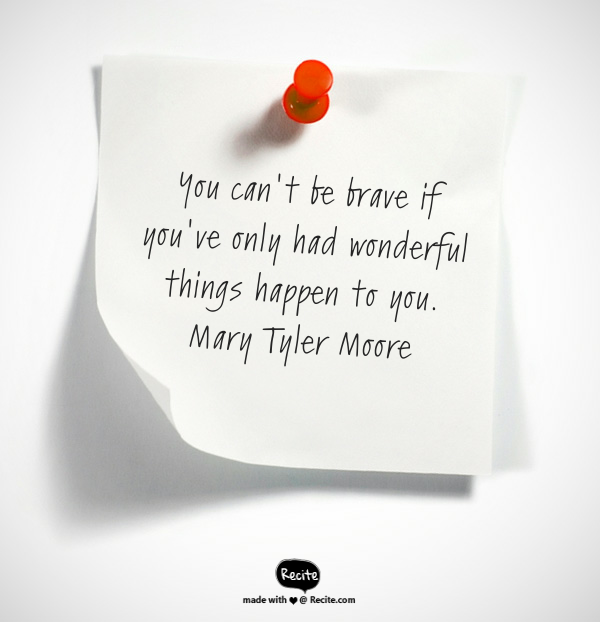
Bravery-Mary Tyler Moore quote

Be brave.