Blog

Day of the Dead, Family, Latino culture, Latinos in film

Day of the Dead in the U.S.A

Day of the Dead
Day of the Dead

The Latin American tradition of “el Dia de Los Muertos,” has crossed over to the U.S. as Day of the Dead (DoD) Celebrations are in more cities and cemeteries than ever before.

One can find DoD items at Williams-Sonoma, Cost Plus World Market, Target, Michael’s, and several other stores. The day has been commercialized and is now part of big marketing just like Halloween and other holidays.

I have mixed feelings about all that and hope the tradition doesn’t get lost through merchandising. I don’t want people to think that DoD is Mexican Halloween because it isn’t.

You might wonder what’s up with Mexican culture and death. And how did the celebration come to the U.S?

This is a story as old as immigration and ancestral traditions.

In the 1970’s Latino activists and artists in the United States began expanding “Day of the Dead” north of the border with celebrations of performance art, Aztec dance, art exhibits, and other public expressions, namely the construction of the altar.

This tradition, embraced by the mainstream, builds community, gives awareness for other traditions, and helps maintain ancestral and cultural identity.

There are several icons which constitute a Day of the Dead remembrance.

Recently, museums across the nation have begun to embrace this tradition as a means of engaging more diverse audiences and highlighting how Latin Americans view death, in contrast to Anglo-Saxons.

My county museum has been celebrating Day of the Dead for several years. This year, I and several others are building an altar to the Mexican and Mexican American film stars of the past 100 years, as a precursor to a film festival we’re hosting next year.

First we had to fold and cut a lot of colorful crepe paper to decorate the three levels of the altar. I’m a craft klutz, but with some individual help, I was able to construct a few papeles.
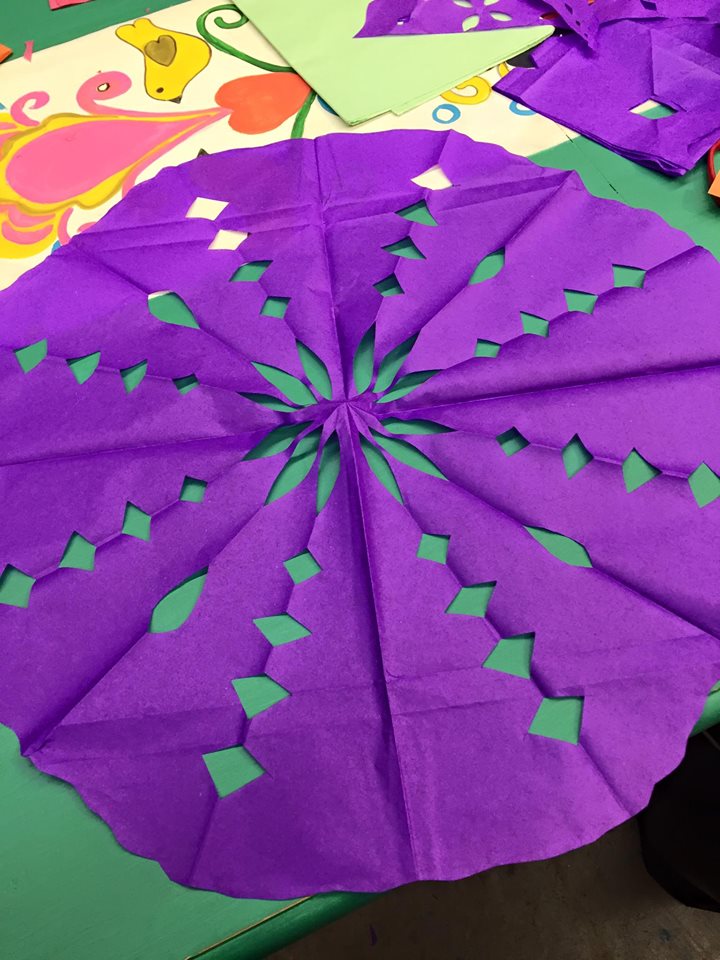
Papel Picado
Papel Picado

Some handiwork from my friends:

Heart and Diamond cuts on Papel Picado
Heart and Diamond cut on Papel Picado

As you can see, just building the altar brings a group together.

Over the next few days, we’ll gather the elements needed to symbolize the four elements: wind, water, earth, and fire. Bunches of cempasuchil (marigolds), photographs, jarros (earthenware jugs or cups), candles, salt, pan de muerto (bread of the dead), sugar skulls and a few other objects.

Here’s a close-up view of a small altar.

Example of Day of the Dead altar.

Expand your horizons and visit a Day of the Dead celebration in your area.
 

Breast cancer, Breast Cancer Action, Breast cancer research, Family, Health, Healthy choices, Inspiration

Don’t Pink for Me: “Poison Isn’t Pretty”

Breast Cancer Action campaign

Every October, the autumn leaves turn golden, the sycamores lose their leaves, and the color PINK is everywhere.

After 30 years of breast cancer “awareness,” have we found a cure? No.

What we have found are three thousand more PINK products, many of which contain carcinogens found to negatively influence cancer.

Don’t get me wrong, I’m grateful for surviving breast cancer. I’m indebted to those who have contributed time and money to BC research. I proudly wore “pink” for the first two years, like some lucky talisman to help me in my travels down the pit of despair.

What gets to me is the commercialization and big corporations making a buck or ten off pink buckets of chicken, yogurt, and toilet paper.

And it sure as hell doesn’t impress me when the NFL cheerleaders dress in pink shorts and rattle pink pom-poms. (According to Business Insider, only 8% of the money from NFL pink merchandise goes to the American Cancer Society).

Now look at this 2015 news:

Recently, some of our members living with breast cancer asked us to look into the cosmetics used in a program for cancer patients called Look Good, Feel Better®.

Look Good, Feel Better is run by the Personal Care Products Council, the largest national trade group for the cosmetics industry, and the American Cancer Society, the nation’s largest cancer charity. They hold free workshops that give beauty tips and complimentary makeup kits to women in cancer treatment—support that some women understandably value while facing a cancer diagnosis.

Look Good, Feel Better bagThe downside? Many of the products offered to women in Look Good, Feel Better kits contain chemicals linked to increased cancer risk, including parabens, Teflon, and formaldehyde releasers.

As if that’s not bad enough, some of the chemicals in Look Good, Feel Better products may actually interfere with breast cancer treatment. For example, methylparaben has been found to both increase breast cancer risk by mimicking the hormone estrogen and interfere with the common cancer drug Tamoxifen.

Since my diagnosis, I’ve tried really hard to keep free of toxins in my food, hygiene, and cleaning products. Shouldn’t a corporation seeking to help survivors do the same?

Where does it go? Some of it goes to the American Cancer Society or other breast cancer organizations. These corporations make big money off pink products. Like the donations from the NFL, these organizations may receive less than 10% of your purchase.

According to Charity Navigator,

…only 71.2 percent of money the ACS receives goes towards its programs. Last time I checked, the program expenses number now sits at 60.6 percent.

Compare this to the Breast Cancer Research Foundation which, according to Charity Navigator, spends 91.9 percent of its funds towards program expenses and its services.

Corporations that want to help can give money to research and provide services for underserved communities and community health clinics.

Charity Navigator gives this advice:

So, how do you evaluate which cause-related marketing efforts are worth purchasing? Start by asking these questions: click this link.

Cause Marketing
Cause Marketing

If you’d like to help fund research, look for those organizations with a mission to do research or focus on the root causes of the disease, like Dr. Susan Love’s Research Foundation or Breast Cancer Action

While you’re at it, sign a petition or two to encourage legislation that will help those with breast cancer, and please use as few toxic chemicals as possible.

So now that I’m done, for the year, with this issue, I’d like to thank my friends and relatives who were there for me when I had breast cancer:

A listening ear, a hug, ice cream, a book, a joke, a phone call, and a pretty card meant the world to me and kept me going. I’ll never forget your kindness.

Source: Tell These Pinkwashers: “Poison Isn’t Pretty”