

I think writer’s, poets, artists have built in weirdness-mostly good weirdness. That’s why I found Jacob Nordby‘s drawing and quote so inspirational.
He says we’re blessed, we see the world through different eyes. His statement makes weirdness a good thing. It’s validating and something to embrace.
I occasionally hear “You writers are weird.” This statement uttered by one of my own kids, usually after he’s ignored the hotel DO NOT DISTURB sign that must turn invisible when I close my door. When he interrupts me for the second time while I’m typing away, I usually shoot him the ‘don’t mess with mom’ look, roll my eyes, or yell “What?!” with a huffy puff, or all three, and yell “Can I just have one hour?!” to which he repeats, “You writers are weird.”
I write in my PJ’s, with my breakfast of coffee and peanut butter toast at the side of my laptop, in my bedroom. When I see/hear/feel something interesting I jot it down on my Note app on my iPhone. Much of the time I live in my head. That’s the ‘right’ side of weird.
What about the left of weird?
Truman Capote. “I am a completely horizontal author. I can’t think unless I’m lying down, either in bed or stretched on a couch and with a cigarette and coffee handy. I’ve got to be puffing and sipping. As the afternoon wears on, I shift from coffee to mint tea to sherry to martinis. No, I don’t use a typewriter. Not in the beginning. I write my first version in longhand (pencil). Then I do a complete revision, also in longhand.”
 |
| Truman Capote 1977-flavorwire.com |
Aaron Sorkin, man behind the West Wing and Social Network has a habit of acting out his confrontational dialogue while gazing at his own reflection. In 2010, he worked himself into such a frenzy that he head-butted a mirror. “I wish I could say I was in a bar fight,” confessed Sorkin, “but I broke my nose writing.”
The center of weird:

Maya Angelou, author of I Know Why The Caged Bird Sings, rises at 5am and checks into a hotel, where staff are instructed to remove all stimuli from the walls of her room. She takes legal pads, a bottle of sherry, playing cards, a Bible and Roget’s Thesaurus, writing 12 pages before leaving in the afternoon and editing the pages that evening. (Someday, but with a nice Cabernet and bar of dark chocolate).
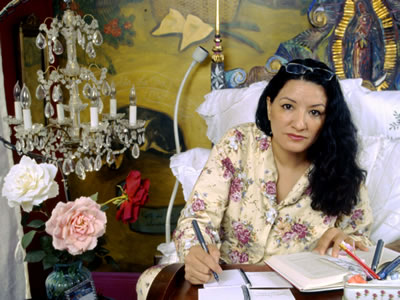
Sandra Cisneros, in a presentation “Writing in My Pajamas,” she says she is usually in her monkey pajamas, with unbrushed hair, writing. “…I am wearing my pajamas and write something in the language I’d use if I was sitting at a dirty kitchen table talking to one person…that’s my first draft…that allows me to sound like me…that’s my truest voice.” This photo is part of the Smithsonian Photo Exhibit-“Our Journeys/Our Stories: Portraits of Latino Achievement,” hence the conservative pajamas.
The far left of weird:
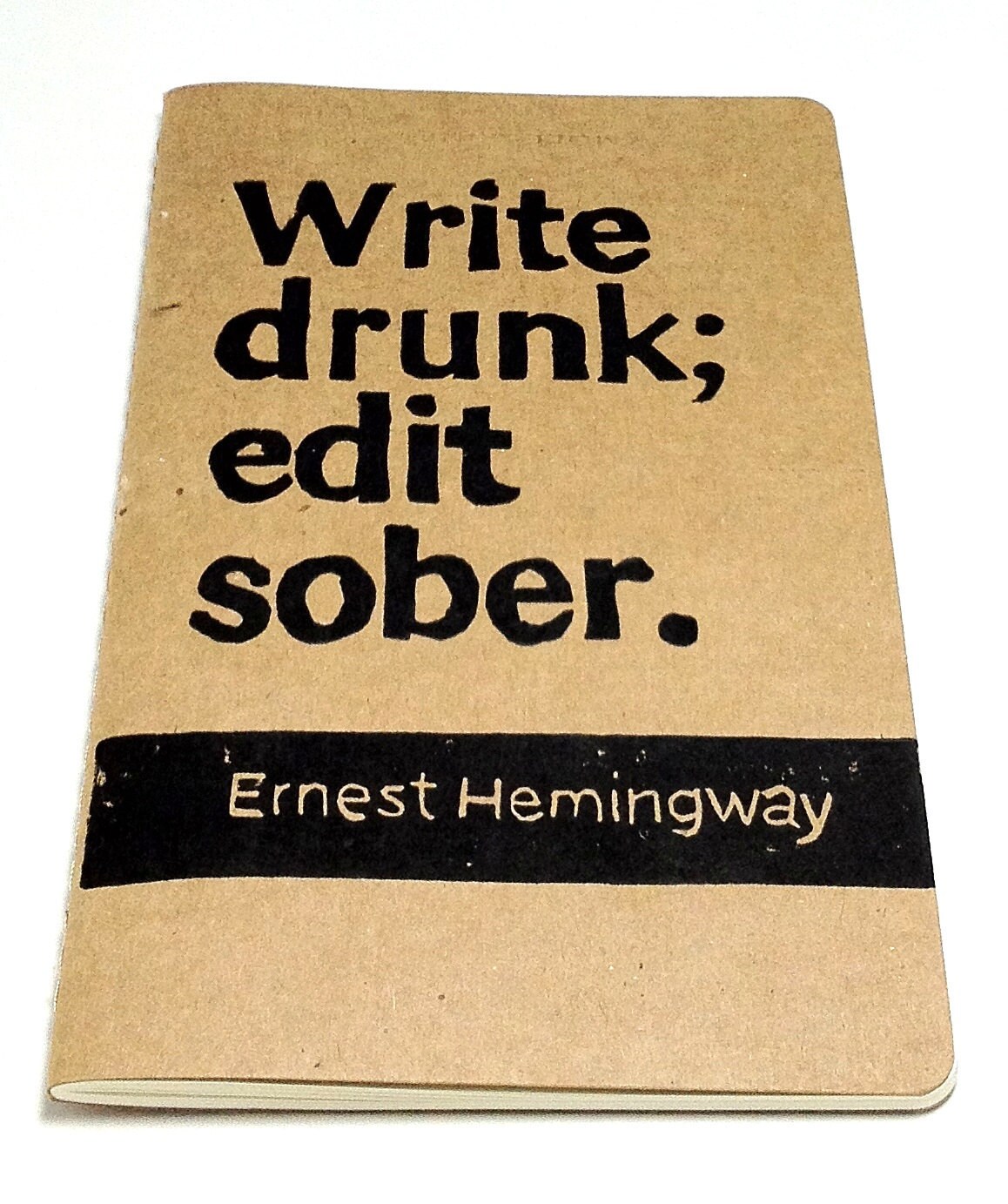
Hemingway said he wrote 500 words a day, mostly in the mornings, to avoid the heat. In the afternoons he got drunk. Though a prolific writer, he also knew when to stop. In a letter to F. Scott Fitzgerald in 1934, he wrote, “I write one page of masterpiece to ninety-one pages of shit. I try to put the shit in the wastebasket.
 |
| Hemingway-flavorwire.com |
Coffee was Honoré de Balzac’s poison. But we’re not talking about an espresso. He would drink vast quantities of black coffee, ensuring that he could write through the day and into the night, once clocking in 48 hours straight.
French novelist Victor Hugo wrote both Les Misérables and The Hunchback Of Notre-Dame in the altogether. Being nude meant he wouldn’t be able to leave his house. As a safety measure, he’d also instruct his valet to hide his clothes.
More nudists: French poet and author Edmond Rostand who is best known for his play Cyrano de Bergerac, was so sick of being interrupted by his friends that he took up working naked in his bathtub. Benjamin Franklin and Agatha Christie liked the bathtub idea too.
Now that you have great examples of great writers being ‘weird,’ think on this:
Where’s your will to be weird?-Jim Morrison
And do fill in the blanks:
I write in _______________with ____________?

 alvaradofrazier.com