Authors, Book Review, Books, Chingonas, Lorraine Liscio, Paris, Paris and her Remarkable Women, Strong Women, Travel, Women in Paris history

Paris and Her Remarkable Women: Book Review


September 2012 will always be have a special place in my heart. That is when I fulfilled a fifteen year dream to spend a month in France.

My friend and I spent one week in Connelles, Normandy area and three weeks in Paris. 

Museums filled our mornings, cafes or parks our afternoons, and strolls along the bridges and boulevards filled our evenings.

With so much to see, feel, and enjoy not much time was left for reading other than perusing the street map for the next day’s adventures. Months later I have finished reading the three books I picked up in Paris.

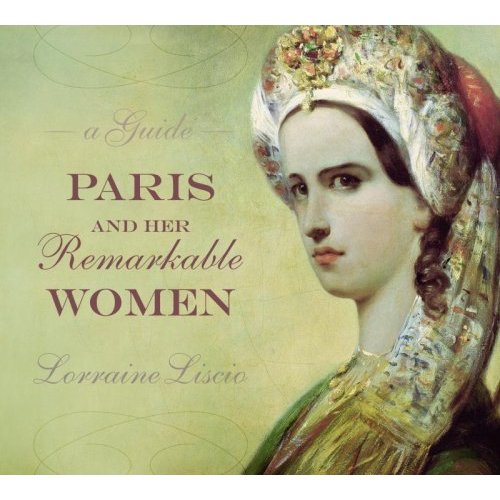
A wonderful book I found at the Musee de la Vie Romantique’s ( Museum of the Romantics) tiny gift store was “Paris and Her Remarkable Women” by Lorraine Liscio. 

The Romantique is one of three literary museums. Located in the ninth arrondissement it is free to enter, has a lovely garden cafe, and small enough to go through in an hour, or two.  It is dedicated to French novelist and playwright George Sand, who was actually Amantine Lucile Aurore Dupin.

Musee Romantique-www.alvaradofrazier.com

What drew me to the book, besides the evocative title, was the blurb on the back cover: 

“To visit Paris is to wander through its history and glimpse its ghosts. The sixteen remarkable women profiled here were protagonists is stories that shape our understanding of Paris, from medieval times to the twentieth century. Yet often the traces of these women have faded…”

The second reason I was drawn to the book was that all of the subjects in Liscio’s book are strong women. They are amazing French chingonas of the arts and sciences. 


The author of “Paris and Her Remarkable Women,” is Lorraine Liscio, who holds an MA in French and a PhD in English. She also served as Director of Women’s Studies at Boston College where she taught literature.

Her resume sounds so “academic” but her writing style is very engaging, filled with the sights and sounds of the different eras in Paris. She includes the residences, museums and other Paris sites where the works of these women are held for posterity. The book makes a wonderful travel guide about the accomplished women in the history of Paris. 

The lives of a saint (Genevieve, Patron Saint of Paris) to scientists (Madame du Chatelet, Marie Curie); writers  (Heloise, Sand, Collete) to feminists (Marie Jean Roland, Christine de Pisan, Simone de Beauvoir); and actors (Eliza Felix, Sarah Bernhardt) to artists (Elisabeth Le Brun, Camille Claudel) are found in this hardcover 126 page book of tantalizing stories. The illustrations and photos in the book give us further insight into the history of Paris. 
The majority of these learned women weren’t “allowed” to attend the schools their male counterparts could attend, but they nevertheless enhanced social and political awareness in a variety of areas. 
We find that some women who were referred to in history as courtesans, mistresses, or lovers of famous men were actually so much more. They were exceptional women who managed to steer their way through time periods which were oppressive to women.
This is a “keeper” book, one which I will place in my bookcase, lend only to select friends and a book that will take me back to Paris whenever I need to get a taste of the City of Light once again. 

Are there any books you’ve collected that take you back to a vacation spot? 


Every Tuesday, over on Thoughtful, there are book reviews. For reviews on a  variety of books click on over to: From The Bookshelf . 
Authors, Aztec, Book Review, Books, Colin Falconer, Malinali Tenepal, Malinche, Mexican History, Strong Women

La Malinche: Heroine or Traitor?

Aztec by Colin Falconer: Book Review.


I read my fair share of books. If I took a photo of my bedroom (and I won’t because the camera on my iPhone 3GS is crappy) you’d see two to three deep rows of books lined up back to back in my tall bookshelf. There are smaller books on top of those rows, only one book deep because I may be messy but i don’t want to squash the books on the bottom.
.
Books totter on an end table, hold up a lamp, crowd on a footstool, and fill a magazine holder meant for, yes, skinny magazines not chunky books. I won’t take you on a tour of the family room or my bathroom. At least my Kindle Fire is dust free and orderly.  


Most of the time I don’t write a review about books that I’ve read. If I had to guess, I’d say I write one long review for every 15 or so books. The rest of the time, and if I remember, I rate the books I read on my Goodreads page or on Amazon. 


Today I felt compelled to review the book “Aztec” by Colin Falconer because it was one of the historical fiction books that left an impression on me, much like Michener’s “Hawaii,” and Villasenor’s “Rain of Gold.” 


“Aztec,” is the story of Hernan Cortes’ invasion and conquest of the Mexica (pronounced Meh-she-ca) natives in the early 16th Century. Falconer tells this enthralling story via several narrators. Cortes and Malinali are the main characters but this is primarily Malinali Tepenal’s (commonly called Malinche) story. 


The main reason for loving this book is because it is told primarily through her perspective. This gives us an understanding of her motivations for doing what she did.The book tells the story of her life, role, and motives as Cortés’ translator of Chontal Mayan and Nahautl, the Aztec language. She became baptized, his concubine and renamed Doña Marina. (Doña is a title like My Lady).


Whether Malinali was a traitor or harlot has been debated for centuries. Historians agree that she was the daughter of a noble Aztec family. Upon the death of her father, a chief, her mother remarried and gave birth to a son. Deciding that he rather than Marina, should rule, she turned her young daughter over to some passing traders and thereafter proclaimed her dead. She wound up as a slave of the Cacique (the military chief) of Tabasco. 

from Codex of Txlacala-Mexico 1519

The Aztecs called Malinali, Malinche. Even today, the word malinchista is a deadly insult, meaning traitor to the Mexican people. This name is also used to say a woman is someone’s mistress or a harlot.

By the time Cortes arrived, Malinali had learned the Mayan dialects used in the Yucatan while still understanding Nahuatl, the language of the Aztecs and most Non-Mayan Indians. She soon learned Spanish. What is not debated in history is a letter preserved in the Spanish archives, from Cortés, which states, “After God we owe this conquest of New Spain to Doña Marina.”
The other facts that arise from this book and history are that Malinali Tenepal was an intelligent, loyal, and fearless woman. She loved Cortés, remained faithful to him, and bore his son, Martín Cortés, who became the first Mexican (a mixture of Spanish and Aztec or native blood).
I enjoyed the way this book was written but it did take a little readjustment in the beginning, especially with the different points of view. It does work, especially since the headings list who is telling the story. This provided for a 360-degree view of the characters motives. I agree with a previous reviewer: there are some typos, but not enough to make me stop reading.
Settings are vivid, descriptive, and in keeping with the landscape, customs, and clothing of the era. The lush imagery and authentic dialogue places one into the setting, giving us an understanding of the motives for the main characters.
Although some of the imagery is gruesome, it is necessary to tell the story. The themes of religion, culture, oppression, ambition, greed, good, evil and love are all explored. The historical facts seem accurate, as well as the use of the native language, description of dress, customs, music, and food.
This book would make for a fascinating screenplay and movie. Colin Falconer is a darn good storyteller.


Just so you know, I did not receive any compensation for this review.