Christmas Traditions, Family, Mexican Holiday food

The Missing Mystery Gift

My Christmas Tree by brillanthues, flickr.com


We have a tradition of opening gifts on Christmas morning at eleven o’clock at my mother’s home. We bring our gifts to my Mom’s very warm house which is filled with the fragrance of cinnamon and coffee and steamed roasted pork tamales.

Christmas morning is a big event for my mom who loves to decorate for every holiday. Nativity scenes, from mini to large, decorate the living room side tables, curio cabinets and fireplace mantle.

We’ve had every kind of tree from a Charlie Brown droopy pine to a snow flocked Noble Fir, but now the tree is a nice replica of a real one with its own multi-colored lights.

Mom and my siblings used to be the ones to decorate the tree, with those old-fashioned big bulb lights and silver tinsel. But that duty has been taken over by her grandchildren or great-grandchildren, who like to help their Nana.

Mom still does all her own shopping, scouring Costco (her favorite place) and several other stores from October to December to buy gifts for her oldest daughter to her youngest great-grandchild.

This holiday undertaking is quite a feat when you realize my mother is in her 80’s and legally blind.

And, it is understandable, that every year there is a missing mystery gift on Christmas morning.

After we have coffee and tamales, twenty or more of us crowd into the living room and wait while my mom decides who’s going to hand out the gifts. Then she sits and watches as everyone oohs and ahhs over her wrapping. She opens her own gifts last.

After the jumble of paper and bows make their way to the carpet, we always have one person who didn’t receive a gift from Nana or one of the boys who got a girls scarf and mitten set or pajamas.

Mom always seems surprised when this happens and goes to her bedroom to find her spiral notepad that contains her gift list. She checks it over and after pronouncing she had a gift for so and so and doesn’t know why it isn’t under the tree, she goes on a hunt through her closet, cedar chest, under her bed and the pantries.

We tell her not to trouble herself, the kids get way too many gifts anyway, and we return to the kitchen for more tamales or clean up the area while Mom goes on her gift hunting quest.
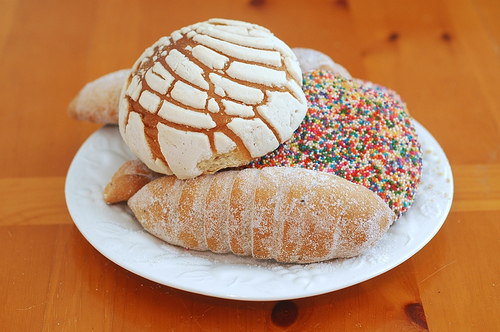
Pan Dulce-Mexican Sweet Bread, flickr.com

This happens every year and the missing gift is resolved by Mom making a note in her pad to buy so and so two gifts next Christmas, which settles the hunt and returns Mom to the kitchen to enjoy champurrado and pan dulce.

But the “two gifts next year” rarely happens because we always forget who had the missing gift in the first place and her Christmas list is on a new spiral notepad.

And as the years go by, we all hope that she will be around for the next holiday whether she buys gifts or not.

Day of the Dead, Family, Latino culture, Latinos in film

Day of the Dead in the U.S.A

Day of the Dead
Day of the Dead

The Latin American tradition of “el Dia de Los Muertos,” has crossed over to the U.S. as Day of the Dead (DoD) Celebrations are in more cities and cemeteries than ever before.

One can find DoD items at Williams-Sonoma, Cost Plus World Market, Target, Michael’s, and several other stores. The day has been commercialized and is now part of big marketing just like Halloween and other holidays.

I have mixed feelings about all that and hope the tradition doesn’t get lost through merchandising. I don’t want people to think that DoD is Mexican Halloween because it isn’t.

You might wonder what’s up with Mexican culture and death. And how did the celebration come to the U.S?

This is a story as old as immigration and ancestral traditions.

In the 1970’s Latino activists and artists in the United States began expanding “Day of the Dead” north of the border with celebrations of performance art, Aztec dance, art exhibits, and other public expressions, namely the construction of the altar.

This tradition, embraced by the mainstream, builds community, gives awareness for other traditions, and helps maintain ancestral and cultural identity.

There are several icons which constitute a Day of the Dead remembrance.

Recently, museums across the nation have begun to embrace this tradition as a means of engaging more diverse audiences and highlighting how Latin Americans view death, in contrast to Anglo-Saxons.

My county museum has been celebrating Day of the Dead for several years. This year, I and several others are building an altar to the Mexican and Mexican American film stars of the past 100 years, as a precursor to a film festival we’re hosting next year.

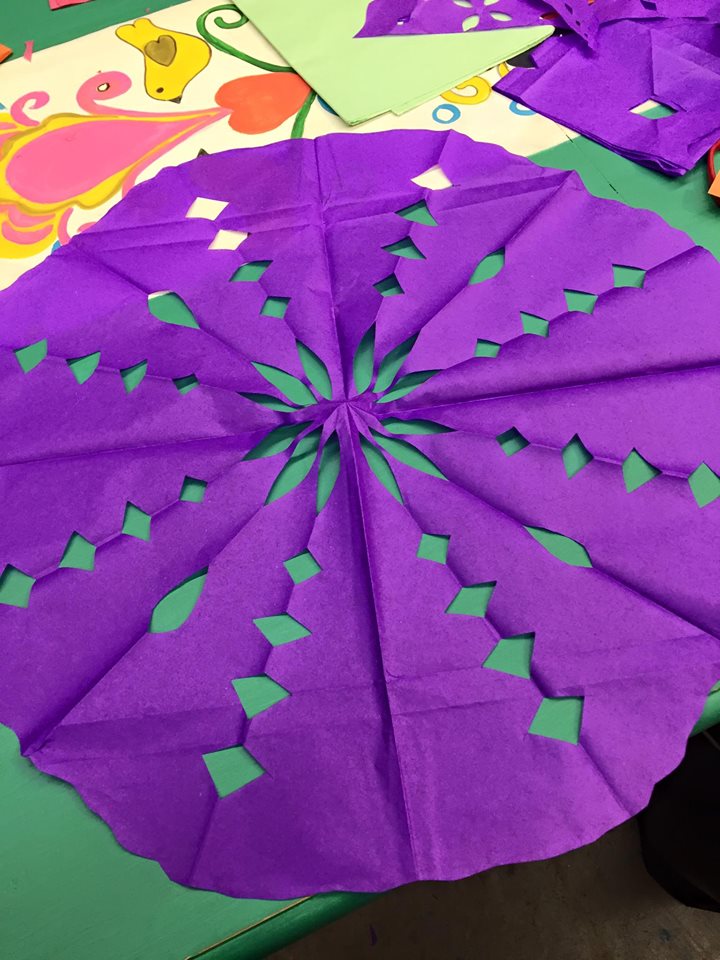
First we had to fold and cut a lot of colorful crepe paper to decorate the three levels of the altar. I’m a craft klutz, but with some individual help, I was able to construct a few papeles.

Papel Picado
Papel Picado

Some handiwork from my friends:

Heart and Diamond cuts on Papel Picado
Heart and Diamond cut on Papel Picado

As you can see, just building the altar brings a group together.

Over the next few days, we’ll gather the elements needed to symbolize the four elements: wind, water, earth, and fire. Bunches of cempasuchil (marigolds), photographs, jarros (earthenware jugs or cups), candles, salt, pan de muerto (bread of the dead), sugar skulls and a few other objects.

Here’s a close-up view of a small altar.

Example of Day of the Dead altar.

Expand your horizons and visit a Day of the Dead celebration in your area.