Family, Parenting

My Son’s Gift On His Birthday

toddler with pinata
Piñata, photo by Marina Montoya, flickr.com


Birds chirped, the fountain dripped and a gardener’s blower punctuated my thoughts.The morning began with wistful moments.

Today is my son’s birthday. A rush of memories swept across my mind’s eye. A baby with his first piñata, a toddler with a potty chair, a new backpack for Kindergarten…

Could it be 30 years? When did he turn 25, 20, or 10 years old?

Did I really go from anxious mother in my ninth month of pregnancy through childhood, up and over the teen years to my son’s adulthood? So soon?

I remember hoarding baby books in preparation for his birth. Post-it notes and highlighter pen colored pages of “What to Expect When You’re Expecting.”

I worked in Whitter, CA commuting from Burbank on treacherous Los Angeles freeways. When I was in my third month my car was rear-ended on Highway 134. An ambulance came when I said I was pregnant.

In my fourth month, I began spotting. My secretary, a mom, took care of me. I was scared to death I might lose a child who I was just beginning to feel deep inside.

I remember the high school track where my husband took me to get exercise, mainly because he gained as much weight as I had by my sixth month.

Once, I saw myself in a full-length mirror during my eight month. In profile. I wore my favorite pink sweatsuit, which was white on the chest and stomach area. “I look like a fat pink kangaroo,” I cried.

We told bits and pieces of these stories to my son on his birthday never leaving out the hospital run. My husband’s old silver Camaro roared down Highway 134 with me clutching the bucket seats, in fear of the excessive speed and the pain of the cramps. Turned out the cramps were Braxton Hicks. He drove slower the next time we went to the hospital, both of us thinking of another false alarm. It wasn’t.

I told my son about the 21 hours of labor and my move from the cool mama birthing room to a cold steel gurney for an emergency C-Section. “All those breathing classes,” my husband said.

Baby, photo by Howard Ignatius, flickr.com
Baby. Photo by Howard Ignatius, flickr.com

His dad told him the ‘hospital story,’ when I wouldn’t leave him after they released me but not him because of jaundice.

“They sent in nurses, a social worker, the doctor, and finally a priest.”

“I wouldn’t budge,” I’d say.

The hospital staff gave in to me saying I’d be responsible for bringing him in three times a day for his Bilirubin counts. We did. The stubbornness of new mothers.

I remember the touch of my son’s silky baby fingers on my face; a blink of recognition from his eyes when he turned to my voice. First words, first everything.

Parents. We remember a toddler’s triumphs on the potty or their discovery of new things. And everything was new.

We remember the stick figure drawings they first gave to us, turkey hands at Thanksgiving, and homemade Christmas decorations from school.

We recall the angst, pimples, broken hearts and we felt life right alongside them. Sometimes.

And then, somehow, when you’re not ready, the years roll by with so many firsts, challenges, and heartaches.

We know we can’t protect our children from everything life will bring, but we pray or hope or nag them thinking we can. We hope they’ll turn to us when life gets hard and they need a listening ear.

The pages of their book, your book too, keep turning.

Sometime today, I will shed a tear (I already am, of course) remembering the gift my son gave me on his birthday.

Family, Latino culture, Stories, Strong Women

An Expert Interview About Mom’s Amazing Oranges

a bowl of oranges
Oranges

Most Sundays I visit my mother. When you spend time with your parents or elders you never know what story they’re going to share.

Mom came into the kitchen from the backyard holding what I thought was a grapefruit.

“From my tree,” her smile and voice triumphant.

She opened her hands and a boulder of an orange rolled onto the kitchen table where I sat reading her Sunday newspaper.

“That’s huge.” My awe not only resulted from the size of the fruit but the fact my mom has a dwarf orange tree making its size more incredible.

The scent of sweetness and tang sprang into the space around us.

“This is a 220,” she said, smiling with every flick of the peel. “At the packing house, we sorted 220’s from 200’s, 210’s.”

“I’m guessing that’s the weight?” I asked.

“Don’t know, but the 220’s were the best of the best. We wrapped them in Sunkist tissue paper before we put them into a special box, all nice.”

vintage citrus label Princess Call Ranch
Sunkist Oranges-Princess label. Creative Commons.

“Like those Harry and David fruit boxes?”

She continued peeling, clearly not hearing my question. Not only is she legally blind, but she has significant hearing loss, not that anyone can really tell of either impairment since she’s so vivacious.

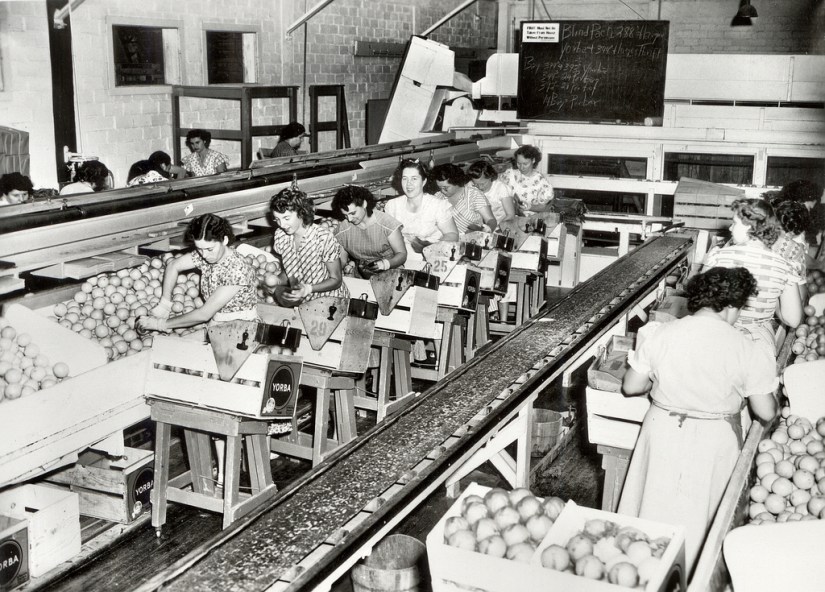
“Ufff, the conveyor belts filled the warehouse, running above us, on the sides, everywhere. There were the regular oranges, the unblemished ones for supermarkets, not a spot on them, and the perfect ones for shipping. And the not so pretty ones for juice.”

I wondered if the beauty of the perfect oranges became a horror at the end of an eight or ten-hour shift where she stood the entire time. Did they still appear beautiful after a thousand oranges rolled by on the conveyor belt?

citrus packing house, 1940's
1940’s photo of interior of citrus packing house-Creative Commons

“Most all the women in the neighborhood worked there. Lots of chisme (gossip) and jokes, the time passed.”

My memory flashed to a summer job I had during college. I worked the graveyard shift in a similar packing house in Oxnard, California sorting strawberries. The women were not so talkative during the night shift.

The conveyor belt rolled at a quick pace while I snatched bruised or overripe berries off the belt and plopped them into the running stream of water alongside the pulleys. The best were shipped to Japan, the worst sent to be made into jelly.

The frigid air reeked of earth and berries, the cold keeping us awake at three in the morning. At the end of the shift, the berries looked like hordes of crawling red spiders.

I finished the strawberry season but that was the last time I worked in a packing house. Mom and her sisters worked in several fruit and chile packing houses for years: Sunkist, S & W, DelMonte.

She often came home, lugging her plastic apron and gloves to wash, reeking of California green chiles, berries, or fruit oil depending on the season. How did she do it? I’m sure she’d say, “You do what you got to do, as long as it’s honest.”

“Now, let’s see if this 220 is sweet,” Mom said. She sectioned the orange with her fingers, piece by piece, working her fingers down the crevices, picking off the white residue of webbing.

She offered me a wedge before she bit into her own piece. Her eyes fluttered with delight. “Ah, a good one.”

My own piece dripped with sweetness. I smiled, not only for the piece of orange but for my mom’s story and opportunity to visit her past.