Books, France, http://schemas.google.com/blogger/2008/kind#post, Renni Brown, self editing, Shelly Lowenkopf, Toni Lopopolo, writer routines, Writing, Writing Resources, writing tips

Tips for an Incredible Writing Weekend

It is the evening of my departure for my month long adventure to France. Some anticipatory butterflies are fluttering through my stomach. 

My bags and travel apps are packed. (And yes, I do need to recharge the battery). 

The kids have heard the Riot Act in a couple of different versions. Everything seems like a go, but I’m sure once I’m on the airplane I’ll remember one or two things that are sitting on my dresser at home and not in my suitcase. 

I know I’ll miss my family, my boyfriend, my dog Chip, (but not KiKi the cat- the feeling is mutual). What I didn’t expect was something that crossed my mind a few minutes ago. 

I’m really going to miss my writing ritual. 

The one where I roll out of bed, stretch, push the power button on my laptop,before I go into the kitchen to make a pot of coffee and return to my swivel chair with a big mug of steaming coffee, a dash of half and half, and my peanut butter toast. For two hours, sometimes more, I type, refill the coffee cup, and blow crumbs off my desk.

When my friend Amada and I arrive in Upper Normandy on the 1st of September we will have to  establish new writing routines. Luckily both of us are early morning writers and both of us like quiet. 

During this Labor Day weekend, I’m sure you will want to squeeze in some time to put pen to paper or fingers to the keyboard. With that thought I’d like to share some tips for your writing weekend. 

1-These 10 gems for first time novelists to think about are from former St. Martin’s Press editor Toni Lopopolo, Agent in her “Bare Knuckle Writing Workshops.” One of the most important tip is: 

Mistake # 9: Poor Self Editing Skills: FTNs haven’t learned to self edit by editing other writers’ fiction, or by reading the recommended books

Sure, you can pay for a professional edit (anywhere from $4 a page to a flat rate of $ 2000) or you can learn how to self edit, make your story stronger, and save the $$$ for a trip abroad or a new roof.

2-A terrific book, Self Editing for Fiction Writers (How to Edit Yourself into Print) by Renni Browne and Dave King (Editors at William Morrow and Writer’s Digest) is a must for a writer. I belong to a writing group, a writing club, and recently the Goodreads pick for our online writer’s group, Wordsmith Studio. This book has been a must read for all three groups. 

The topics which first time novelists find hard to grasp and usually lack in their stories are:

  •  three dimensional characters, 
  • maintaining point of view, 
  • interior monologue, and 
  • voice

This handy reference book delves into subjects such as showing and telling in a way as to engage the readers’ emotionsEach of the 12 Chapters has a checklist so that you can apply the concepts to your work. 

If you’re not at the self editing stage yet, here are some amazing questions and tips about story, from an instructor I’ve had the privilege to meet. 

3-Shelley Lowenkopf is an editor, writer, and Professor Emeritus at USC. In his Seven Things You Write A Story to Discover you are asked to consider the who, what, where, why and more of story. The question, “Why should we care?” is most important.

We tend to care about stories dramatizing experiences that squeeze characters in ways similar to the squeezes and pressures we have experienced.  We care if someone we identify with is vulnerable.” 

 If the reader doesn’t care, they will stop reading. End of story. 

4-For those of you who are in the throes of revision here’s a handy guide that explains editing marks-you know those scribbles all over your work in progress or manuscript.  

Author’s Success Platform

I’m going to skip tip # 5 for another day, another post, because this one is longer than I anticipated. IF you have a 5th tip let us know in the comment section. We really want to know.


Now, I must get back to the suitcase on the floor and cast out some unlucky clothes. 

And remember, before you start your Writer’s Weekend please:


 Au Revoir Mon Ami’s.

Adam Sorkin, Agatha Christie, Authors, Balzac, Encouragement, Jim Morrison, Maya Angelou, Sandra Cisneros, Truman Capote, Victor Hugo, Weird writer habits, Wisdom, Writing

Weird Writer’s and Other Artists

I think writer’s, poets, artists have built in weirdness-mostly good weirdness. That’s why I found Jacob Nordby‘s drawing and quote so inspirational. 

He says we’re blessed, we see the world through different eyes. His statement makes weirdness a good thing. It’s validating and something to embrace. 

I occasionally hear “You writers are weird.” This statement uttered by one of my own kids, usually after he’s ignored the hotel DO NOT DISTURB sign that must turn invisible when I close my door. When he interrupts me for the second time while I’m typing away, I usually shoot him the ‘don’t mess with mom’ look, roll my eyes, or yell “What?!” with a huffy puff, or all three, and yell “Can I just have one hour?!” to which he repeats, “You writers are weird.” 

I write in my PJ’s, with my breakfast of coffee and peanut butter toast at the side of my laptop, in my bedroom. When I see/hear/feel something interesting I jot it down on my Note app on my iPhone. Much of the time I live in my head. That’s the ‘right’ side of weird. 

What about the left of weird? 

Truman Capote. “I am a completely horizontal author. I can’t think unless I’m lying down, either in bed or stretched on a couch and with a cigarette and coffee handy. I’ve got to be puffing and sipping. As the afternoon wears on, I shift from coffee to mint tea to sherry to martinis. No, I don’t use a typewriter. Not in the beginning. I write my first version in longhand (pencil). Then I do a complete revision, also in longhand.

Truman Capote 1977-flavorwire.com


Aaron Sorkin, man behind the West Wing and Social Network has a habit of acting out his confrontational dialogue while gazing at his own reflection. In 2010, he worked himself into such a frenzy that he head-butted a mirror. “I wish I could say I was in a bar fight,” confessed Sorkin, “but I broke my nose writing.”

The center of weird:

Maya Angelou, author of I Know Why The Caged Bird Sings, rises at 5am and checks into a hotel, where staff are instructed to remove all stimuli from the walls of her room. She takes legal pads, a bottle of sherry, playing cards, a Bible and Roget’s Thesaurus, writing 12 pages before leaving in the afternoon and editing the pages that evening. (Someday, but with a nice Cabernet and bar of dark chocolate). 


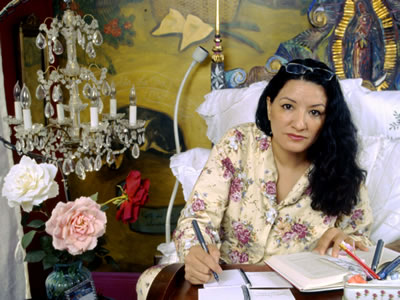
Sandra Cisneros, in a presentation “Writing in My Pajamas,” she says she is usually in her monkey pajamas, with  unbrushed hair, writing. “…I am wearing my pajamas and write something in the language I’d use if I was sitting at a dirty kitchen table talking to one person…that’s my first draft…that allows me to sound like me…that’s my truest voice.” This photo is part of the Smithsonian Photo Exhibit-“Our Journeys/Our Stories: Portraits of Latino Achievement,” hence the conservative pajamas. 


The far left of weird: 

Hemingway said he wrote 500 words a day, mostly in the mornings, to avoid the heat. In the afternoons he got drunk. Though a prolific writer, he also knew when to stop. In a letter to F. Scott Fitzgerald in 1934, he wrote, “I write one page of masterpiece to ninety-one pages of shit. I try to put the shit in the wastebasket.

Hemingway-flavorwire.com

Coffee was Honoré de Balzac’s poison. But we’re not talking about an espresso. He would drink vast quantities of black coffee, ensuring that he could write through the day and into the night, once clocking in 48 hours straight.

French novelist Victor Hugo wrote both Les Misérables and The Hunchback Of Notre-Dame in the altogether. Being nude meant he wouldn’t be able to leave his house. As a safety measure, he’d also instruct his valet to hide his clothes.

More nudists: French poet and author Edmond Rostand who is best known for his play Cyrano de Bergerac, was so sick of being interrupted by his friends that he took up working naked in his bathtub. Benjamin Franklin and Agatha Christie liked the bathtub idea too. 

Now that you have great examples of great writers being ‘weird,’ think on this:

Where’s your will to be weird?-Jim Morrison

 And do fill in the blanks:

 I write in _______________with ____________?