A dramatic work has only one central character. There may be secondary characters of equal importance to the overall narrative, but in the vast majority of literary accomplishments from Dracula to Candide, Tootsie to RichardIII,Madame Bovary to Priscilla, Queen of the Desert, there is only one central character. This character’s motive—what he/she wants in terms of a goal or objective–drives the story. This is the engine, the seminal force of the action. Action is the operant word in story, fluid and unrelenting, not to be confused with activity, which is often casual and directionless. The central character’s determination to follow what is often an obsessive course propels the action. This energy connects us to the central character. This dominant skein in a story commands our attention.
This imperative may also be subtle. Take Shakespeare’s Romeo and Juliet;
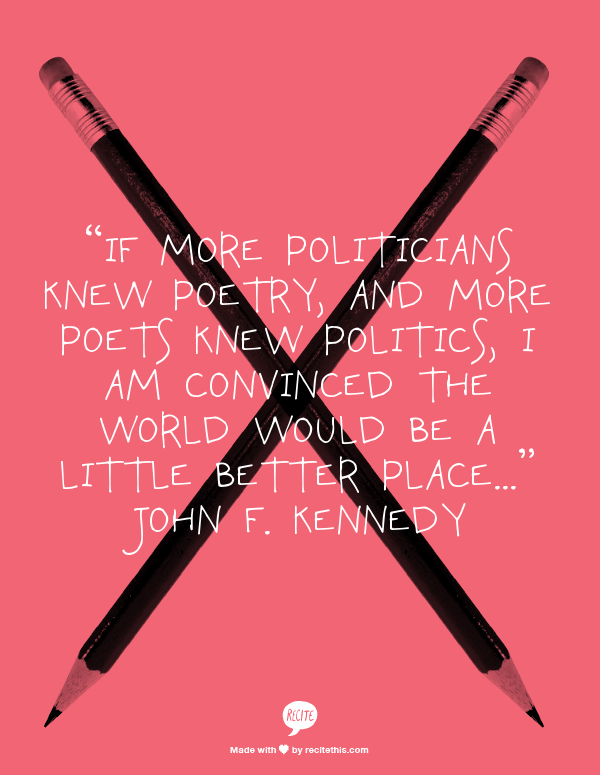
Poetry and Politics-JFK quote. alvaradofrazier.com
Remember high school English classes?
That was my first introduction to poetry. Old poets. Lot’s of ‘thee’s and thou’s,” and too much Old English stuff.
I was a studious person, more logical than emotional, so many poems went over my head.
That was until I went to college, in the mid ’70’s. It was an eyeopener when I read the profound words of contemporary poets Maya Angelou and Nikki Giovanni, who spoke of racism and the strength of women.
I found only two Chicano/Mexican American poets, both male: Alurista and the political activist, Rudulfo “Corky” Gonzales.
Yo Soy Joaquin, I am Joaquin, gripped me from the beginning.
This bilingual poem, published in 1967, summarized Mexican and Mexican American history, from the exploitation of the natives through colonial times, to the present. The poem served as a nationalist ideology for political activism, using the historical events of the 19th Century social rebel, Joaquin Murrieta.
The poem was groundbreaking, revitalizing, and began a social movement. Since it is several pages long, here’s an excerpt from the middle of the poem:
I am Joaquin. I rode with Pancho Villa, crude and warm, a tornado at full strength, nourished and inspired by the passion and the fire of all his earthy people. I am Emiliano Zapata. “This land, this earth is OURS.” The villages, the mountains, the streams belong to Zapatistas. Our life or yours is the only trade for soft brown earth and maize. All of which is our reward, a creed that formed a constitution for all who dare live free! “This land is ours . . . Father, I give it back to you. Mexico must be free. . . .” I ride with revolutionists against myself. I am the Rurales, coarse and brutal, I am the mountian Indian, superior over all. The thundering hoof beats are my horses. The chattering machine guns are death to all of me: Yaqui Tarahumara Chamala Zapotec Mestizo Español. I have been the bloody revolution, The victor, The vanquished.
In the 80’s and ’90’s, I fell in love with poems and novels by Sandra Cisneros. My love affair with Ms. Cisneros’ work is well documented on my blog. For me, her poems in “Wicked, Wicked Ways” and “Loose Woman,” spanned the politics of women.
Ms. Cisneros is my ‘she-ro.’ My favorite poem is “You Bring Out the Mexican In Me.”
It’s also fairly long, so I’ll print one of her short poems:


 alvaradofrazier.com