Breast cancer, Breast Cancer Action, Breast cancer research, Family, Health, Healthy choices, Inspiration

Don’t Pink for Me: “Poison Isn’t Pretty”

Breast Cancer Action campaign

Every October, the autumn leaves turn golden, the sycamores lose their leaves, and the color PINK is everywhere.

After 30 years of breast cancer “awareness,” have we found a cure? No.

What we have found are three thousand more PINK products, many of which contain carcinogens found to negatively influence cancer.

Don’t get me wrong, I’m grateful for surviving breast cancer. I’m indebted to those who have contributed time and money to BC research. I proudly wore “pink” for the first two years, like some lucky talisman to help me in my travels down the pit of despair.

What gets to me is the commercialization and big corporations making a buck or ten off pink buckets of chicken, yogurt, and toilet paper.

And it sure as hell doesn’t impress me when the NFL cheerleaders dress in pink shorts and rattle pink pom-poms. (According to Business Insider, only 8% of the money from NFL pink merchandise goes to the American Cancer Society).

Now look at this 2015 news:

Recently, some of our members living with breast cancer asked us to look into the cosmetics used in a program for cancer patients called Look Good, Feel Better®.

Look Good, Feel Better is run by the Personal Care Products Council, the largest national trade group for the cosmetics industry, and the American Cancer Society, the nation’s largest cancer charity. They hold free workshops that give beauty tips and complimentary makeup kits to women in cancer treatment—support that some women understandably value while facing a cancer diagnosis.

Look Good, Feel Better bagThe downside? Many of the products offered to women in Look Good, Feel Better kits contain chemicals linked to increased cancer risk, including parabens, Teflon, and formaldehyde releasers.

As if that’s not bad enough, some of the chemicals in Look Good, Feel Better products may actually interfere with breast cancer treatment. For example, methylparaben has been found to both increase breast cancer risk by mimicking the hormone estrogen and interfere with the common cancer drug Tamoxifen.

Since my diagnosis, I’ve tried really hard to keep free of toxins in my food, hygiene, and cleaning products. Shouldn’t a corporation seeking to help survivors do the same?

Where does it go? Some of it goes to the American Cancer Society or other breast cancer organizations. These corporations make big money off pink products. Like the donations from the NFL, these organizations may receive less than 10% of your purchase.

According to Charity Navigator,

…only 71.2 percent of money the ACS receives goes towards its programs. Last time I checked, the program expenses number now sits at 60.6 percent.

Compare this to the Breast Cancer Research Foundation which, according to Charity Navigator, spends 91.9 percent of its funds towards program expenses and its services.

Corporations that want to help can give money to research and provide services for underserved communities and community health clinics.

Charity Navigator gives this advice:

So, how do you evaluate which cause-related marketing efforts are worth purchasing? Start by asking these questions: click this link.

Cause Marketing
Cause Marketing

If you’d like to help fund research, look for those organizations with a mission to do research or focus on the root causes of the disease, like Dr. Susan Love’s Research Foundation or Breast Cancer Action

While you’re at it, sign a petition or two to encourage legislation that will help those with breast cancer, and please use as few toxic chemicals as possible.

So now that I’m done, for the year, with this issue, I’d like to thank my friends and relatives who were there for me when I had breast cancer:

A listening ear, a hug, ice cream, a book, a joke, a phone call, and a pretty card meant the world to me and kept me going. I’ll never forget your kindness.
Source: Tell These Pinkwashers: “Poison Isn’t Pretty”

Family, Inspiration, Parenting, Strong Women

The Pope and My Mother

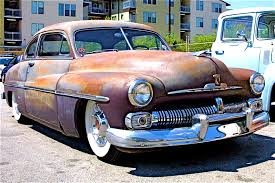
old 1950 Mercury car
1950 Mercury

I’m not a Catholic anymore, but like millions of people, I watched Pope Francis’ visit to Washington D.C and the other parts of America.

Since the day he became Pope, I admired his Christian demeanor and his actions above rhetoric. His compassion for the homeless, the children, and immigrants reminded me of a lesson my mother taught my siblings and I a long time ago.

Those were the days of welfare commodities, those big silver containers of oily peanut butter, Spam, powdered milk and eggs. Mom was a divorcee, a single parent with four kids who went to night school to get her diploma after her full-time job.

An asphalt parking lot separated the housing projects, the apartment buildings where we lived. The lot served as a playground for roller skating, a game of tag, or kickball between cars. 

Amid the old Chevy’s, work trucks, and cars on their last legs, sat a hulking tank of a car, decades old, early 1950’s Mercury. Rimless, faded paint, and worn tires made it look ready for the junk yard. The car had a larger front end than a behind with a huge dashboard full of newspapers and junk, blankets in the rear seat.

We found out a man lived in the car. White stubble dotted his chin and neck against the mahogany of his skin color. He appeared overweight since he wore layers of clothes. A black jacket with sweaters over shirts, blue overalls, red bandanas in his pocket. Skimpy mittens stretched over large hands to ward off the cold. He wore a Charlie Chaplin type hat.

The round man who matched his heavy set car slept in a parking lot of cars that left at dawn for the packing houses, dairy, or vegetable fields. Sometimes he used someone’s water hose to douse his head and face. Drying himself with his bandana.

Sometimes he got drunk on cheap wine, telling us he was from the south, never naming the state or maybe we didn’t ask. There was no work, his jalopy broke down near our apartments and he pushed it into the lot, living there ever since.

When he got drunk he’d reach into his pockets, pull out pennies and nickels and throw them into the air. Kids dove for the coins, it was like bolo, being at a Catholic baptismal when the baby’s godfather threw coins on the church steps to celebrate the event.

One morning he came to our back door, hat in hand, asking my mom if she had some spare bread, water, maybe a sandwich?

We watched her from the kitchen table, making a sandwich with some of our fried Spam. She found a mason jar and filled it with iced tea. He glanced from her to us, to his scuffed brown boots and back again, staring at the concrete.

He took his sandwich and tea with many thanks, a big smile, saying “God bless you,” several times. My mom nodded. When she shut the door one of us said something about the wino and why did she give him some of our food. She corrected us saying he was down on his luck, and he needed help. She grew up during the great depression and knew what hunger felt like and we were Catholics, it was our duty to help other people.

After that, mostly during payday, Mom would make him refried bean burritos, kept hot by wrapping them in aluminum foil. She filled the mason jar with tea and send us out to the parking lot to give to the man. The other neighbors occasionally fed him too, bringing him something they picked from the orchards or field. One day we went outside to play and his car was gone. 

I imagined he found a job, lived a better life, but I don’t know what happened to the homeless man. What I do remember is the compassion my mother showed to someone who was poorer than we were, reminding us we had a duty to help others.

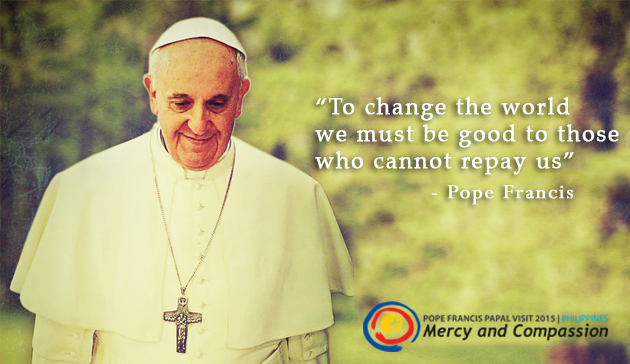
Pope Francis quote on mercy and compassion
Pope Francis on Compassion