Birthdays, Chingona, Death, Family, Parents, Strong Women

A Meaningful Life

alvaradofrazier.com


It’s my mother’s birthday. She’s on the other side of her early 80’s. 

Still a rebel with a cause. A chingona of the first degree, a strong woman.

Loves to eat, tell us stories, have a beer sometimes (only Corona), and laugh. 

We celebrated yesterday at a birthday barbeque in the backyard surrounded by four generations. 

Her favorite menu of carne asada, corn on the cob, chocolate cake with raspberries were among the spread. We forgot her diabetes for one meal. We didn’t want another tussle.


Amidst the talk of another year gone by, she begins counting grandchildren and greatgrandchildren, thirteen in total.  

“Look,” a friend said to mom, “look at all these fires you started.”

Mom leaned back, she looked pleased and nodded.

I heard her whisper, “Maybe my last year.” She’s been saying those words for the last several months. 

She reminds me that she’s glad I wrote down the stories of her childhood four years ago and gave them to my siblings and cousins. 

“It’s a good title, ‘Remembering before I Forget,’ she said, “because I’m really forgetting now.” And that reminds me that I have to revise the stories. Her cousin says that she recalled a few incidents incorrectly.  

She turns melancholy. It’s hard for her being the last sibling alive. We never had grandparents on her side of the family. She was orphaned at a young age. Remembering that she’s the last one alive is hard for me too. Sometimes I feel guilty we still have her and my cousins don’t have their moms and dads anymore. I think about how they feel when they see her.  

Mom looks to a near future of death, preparing for it by making all the arrangements and payments for her plot, selecting her songs, specifying the flowers, writing down her pall bearers (to include her granddaughters), giving me cards for the man who releases the doves. 

“And no crying, celebrate. I want Mariachi’s to play.”

Everytime I hear her say this I choke up. I’m gonna cry. I know it. And I don’t care. Many, many people will cry. And then I’ll remember all the funny stuff she says and does, all the while laughing. We’ll cry and later laugh, loud.  That’s a family thing, we laugh loudly.

We’ll remember her push for college, her feistiness, her marches for justice, persistence, her green thumb, her love of reading, her travels, her stories about her barrio. We’ll remember it all. 

But the time to cry isn’t now. 

We toast to her health and more birthdays to come. 
Family, Health, Latinas, Latinas and sexuality, Latino culture, Menstruation, sexual health

Latinas and Sexuality: 70’s style

latinovations.com 

In a previous post on  cervical cancer awareness I touched on the topic of Latinas and sexuality. 

My experience is that it is often a taboo subject, one that is not discussed between Latina mothers and daughters.

In the late 60’s, early 70’s, the topics of  sexuality or sexual health for twelve year olds usually came in the form of “The Non-Talk.” 

“The Talk” can range from the first talk (menstruation) to sexual intercourse to the last talk (pregnancy). 

In my case, and  for those Latinas of my generation, “The Non-Talk” was usually along these lines:

“The Kotex are in that purple box…Keep your legs closed…Don’t come home pregnant…Wait til your married, only putas have sex before that…” 

or no conversation at all. 

This was the case in my pre-teen and teen age years. My mother didn’t discuss menstruation,  instead my friends had “The Talk” with me on the playground of my Catholic grammar school when I was in seventh grade. I was the oddball who hadn’t started my period  and I was  12 1/2 years old. “Oh my god, it’s kinda of gross, but kind of cool too, ‘cuz you become a woman,” was the gist of the conversation.

When I asked my friends who told them about their periods, all of them said their older sisters. Well, I was on my own. I was the oldest in my family and my school didn’t have sex education classes.

This ‘period’ thing sounded intriguing and yukky at the same time but I had to find out what I was in for so I steeled myself and right before bedtime I asked my mother (in a whisper because my younger sister shared the bed) what ‘periods’ were and when would I get mine. She screwed up her face, shot me a disapproving look and turned off my light. 

from mommymandy.com

One morning, about three days later, I woke up and found a pamphlet under my pillow. Yes, it was the Menstruation Fairy. The booklet described, in cartoon fashion, the wonder of menstruation. I couldn’t make heads or tails of the drawing of the female reproductive system, it looked like a fancy Y to me. 

That evening my mom whispered. “The box you’ll need is in the bathroom closet, in the back, the purple box.” Figuring out how to use these oversized overstuffed pads is another story. Can I get a witness? 

As I thought of this subject I speculated that perhaps my opinion was based on my age and generation. 

Maybe the topic isn’t as taboo as it was in the 70’s. 

Maybe parents having discussions with their sons and daughters about sexuality and sexual health improved in the last 40 years. 

Alas, this is not the case even after thirty plus years of sex education in schools:

  • A 2011 Centers for Disease Control and Prevention (CDC) survey indicates that more than 47 percent of all high school students say they have had sex. Among students who had sex in the three months prior to the survey, 60 percent reported condom use and 23 percent reported birth control pill use during their last sexual encounter.
And for Latinas specifically:
  • While teen pregnancy rates have dropped across all ethnic groups over the past decade, the decline has been smallest among Latinas
  • The percentage of female teens using any method of contraception at first sexual intercourse was lowest for Latinas (57 percent), compared to non-Hispanic whites (81 percent), Asian Americans and Native Americans (77 percent each), or African Americans (68 percent)
  • Among teens, Latinas had the highest birth rate in 2000 (94 per 1,000 women ages 15 to 19). By comparison, the teen birth rate among African Americans was 79 per 1,000; among Native Americans, 68; among non-Hispanic whites, 33; and among Asian Americans, 22 (all studies cited in advocatesforyouth.org)

Religion, cultural norms, access to medical services,  language barriers, and the degree of acculturation (first generation versus third generation) can impact the outcomes.

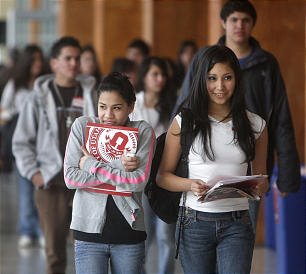
Studies show that family and culture are very important in the lives of Latina teens. Parents and other family members can be significant in providing positive guidance and emotional support. 

I venture to say that providing an atmosphere of trust, age appropriate information and positive guidance will enhance any young girls development. 

It isn’t easy having a conversation about sex and sexual health, but it is imperative. I scripted out how I was going to discuss menstruation with my daughter when she was nine. I’m so glad I did because she began menstruating a few months later and she was able to tell me and her dad when it happened. (He went out and bought her flowers). 

Having conversations about sexuality, in a series of ongoing discussions, made it so much easier throughout the years with both my daughter and two sons. 

Who had “The Talk” with you? Did you have “The Talk” with your kids? Will you?