" Strenght, Inspiration, Latino culture, Mothers, Strong Women

An Emerging Battlecry, A Powerful Memory

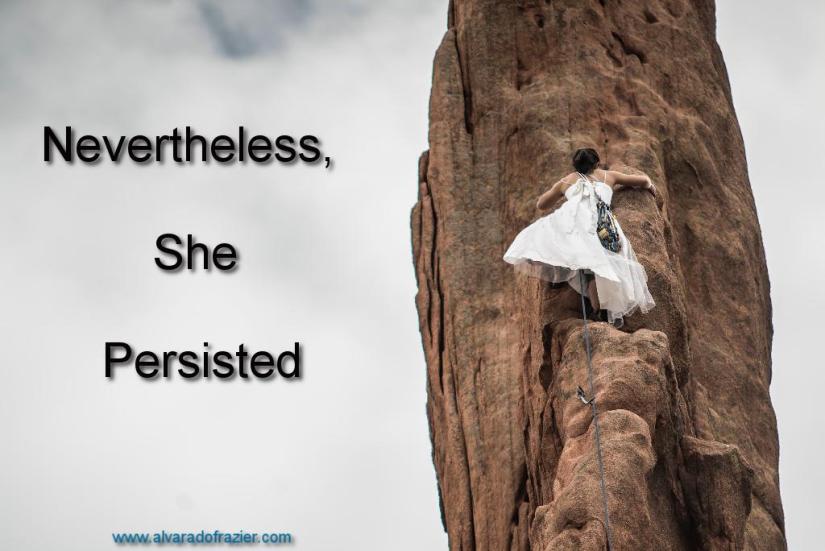
Woman in a dress climbing rock
Nevertheless, She Persisted. Photo by Dylan Siebel, Garden of the Gods, CO, unsplash.com

Senator McConnell employed a seldom-used rule on Senator Elizabeth Warren last week, but in the end, his words unleashed a new battle cry for thousands if not millions of women.

His attempt to quiet her angered people to the point where his quote trended on Twitter and became a business enterprise of tee-shirts, cups, and demonstration signs.

He may have shut her up for the moment, but not in the long run.

This emerging battle cry pokes at tender memories of times when people attempted to shut us (women) up.

For me, the words, “Nevertheless, she persisted,” took me back to my childhood.

In the kitchen sat my uncle, the older brother to my mom. The thud of a Coors beer can hit the metal table. Something pissed him off. My aunt shooed us into the living room.

“What do you mean, school?”

Mom told him she signed up for night school to get her diploma.

“Mothers take care of their kids, they stay home. We live two hours away, who’s gonna watch them? Not strangers.”

His wife didn’t work outside the home. She took care of us during the summers, when Mom worked two jobs. Mom was divorced, four kids under nine years old.

Usually, my uncle was a loving brother, a responsible man who financially helped us whenever he could. My aunt always there with a burrito, glass of milk and a joke to make us laugh.

Mom gave him the details about night school, classes from seven to ten at night, four days a week. She had a babysitter for us, a neighbor. She could get her high school diploma in a year if she worked hard, and she promised she would.

“You don’t need a diploma to work the packing house.”

I could see her enthusiasm wane, her smile faded. She picked at her fingernails. Mom turned into a little girl before my eyes. I wanted to tell my uncle Mom worked hard, she stood for eight to ten hours, her hands sorting vegetables in a cold factory. Her plastic apron stunk, even after she washed it late at night. But he knew that already.

“I don’t want to work in the fields or a factory for the rest of my life. I want an education.”

My uncle made decent money working construction, they had a house, a car. We lived in the projects, no car and had to eat powdered eggs and have Spam for dinner.

“I can get a better job with a high school diploma, go to community college …”

His fist hit the table. “Ay, sí, college. What the hell are you thinking?”

Mom shrunk into her chair.

“You don’t even have a car,” he said.

“I’ll take the bus, like we do now,” Mom’s voice grew stronger.”Or walk.”

This scene persisted after my uncle and aunt left. A neighbor, a man who encouraged his sons to go to college, acted like my uncle when he heard Mom attended night school.

She received her diploma a year later. After that, she went to on to community college. My uncle bought her a beat up used car, but it got her to the next city to attend night classes.

Mom graduated with her A.A degree the same year I graduated from eighth grade. She scrimped and saved, sought out every scholarship, and applied for better jobs. Four years later, working full time, she earned two Bachelor of Science degrees from a Cal State University.

Nevertheless, she persisted.


Family, Latino culture, Latino Family Traditions, Parenting

How Tamales Make My World A Better Place

Ingredients for making 'Green' Tamales
Ingredients for making ‘Green’ Tamales

Every December, I write about making tamales, and this year is no different.  Our mother has made tamales for over seventy years, longer than her children have been alive. And her mother made tamales before she was born. And her mother, back to the days of maize and metates.

Something is wrong with my universe if our family stopped making Christmas Tamales. Our world can be is disarray, but we come together, three or four generations of our family and spend an entire day making tamales.

Keeping our tradition alive is like maintaining a bridge beginning in the past crossing to the present and spanning into our future. It’s family represented with food.

The name tamale comes from the Nahuatl (Aztec) word ‘tamalli,’ meaning ‘wrapped.’ The masa (maize) for the tamales come from our indigenous roots and have names from our ancestor’s primary language (Spanish/Nahuatl). Making tamales, for me, is maintaining our culture.

In the past, I’ve written about our Tamale Tactical Plan, The Five Important Ingredients for the Best Tamales, and the Tamales and Traditions post. Everything you wanted or didn’t want to know about tamales is in one of those posts.

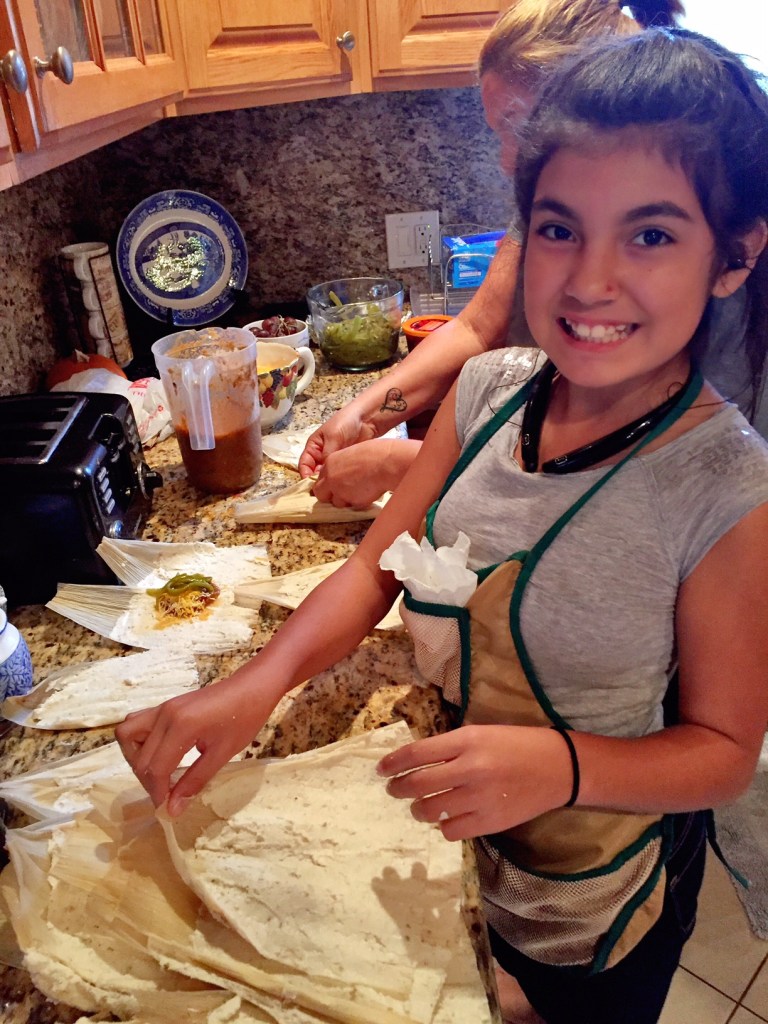
This year four generations of our family donned our favorite aprons to make ‘green tamales’ or tamales de rajas. Right before Christmas we’ll make the ‘red tamales,’ or the red chile and pork tamales.

On our table, (picture above) in the twelve o’clock position is the masa preparada (prepared corn meal), at three o’clock, are strips of Ortega California green chile, at six o’clock, is more masa, at eight o’clock, is shredded Monterrey and Cheddar (a big mistake-use Monterrey only), at nine o’clock, is a pitcher of homemade chile, and in the center are the soaked corn husks, or ojas. We use a knife to spread the masa onto the oja; some people are adept with a spoon or a tamale spreader that looks like a cement masonry spreader. We are butterknife people.

Assembly line style, the five of us (four generations) spread the masa onto the oja and fill up every spot on the table. Two people stuff and fold the tamales. To get this important job you have to work your way up from tamale spreader to the stuffer.

This year, my eleven-year-old niece (representing the fourth generation) who graduated to tamale stuffer last year. You can see how proud she looks. She’s been helping since she was five years old. That’s her grandmother beside her (the second generation).

Corn husks with masa ready to be stuffed-www.alvaradofrazier.com
Corn husks with masa ready to be stuffed by the fourth generation-www.alvaradofrazier.com

I remember when her mother was five and helped spread masa on the corn husks. Truthfully, she spread more on the table than on the ojas, but that’s how you learn. This is a picture of her now (she’s the third generation).

spreading tamale masa
Tamale Time with the third generation. http://www.alvaradofrazier.com

This is how traditions are carried on through the years, from the parents to the children. It’s one of the touchstones that ground us to this world. For us, it’s part of parenting.

My portion of the tamales is in the freezer, ready to make the trip to Denver for a snowy white Christmas. While I’m there, I’ll make tamales and carry on the tradition, with a vegan twist, with my son and daughter.

Many of you are from different cultures and places in the world. I’d love to know what traditional food you make during this time of year. If you have a link to a post you’ve written about your tradition, please include it in the comment section so we can visit your home and kitchen.

Thank you and enjoy the holiday season.