Last week I mentioned Poetry Month and how I’d contribute to the celebration of words.
Because I just learned how a Haiku is structured, by terrific instructor Sonya Sones, I decided to do a Haiku for POW day.
Traditional Japanese Haiku not only have 17 syllables, they must also contain an inference or allusion to nature or season, in an unrhymed sequence, and be in the present moment. Very Zen like.
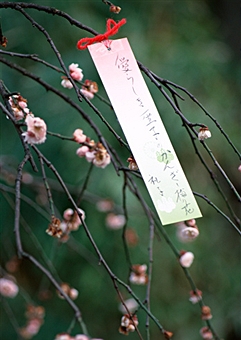
Haiku on Cherry Blossom-gettyimages
There are several forms/rules on the traditional, but for my novice self I’m adhering to the 5/7/5 syllables for each line:
You can’t force poems-they
force you to pick up a pen
and write the words you hide
Richard Wright, author and poet, composed over 4,000 Haiku’s during the last 18 months of his life. Prolific, indeed.
These three are traditional Haiku’s and some of my favorites:
Whitecaps on the bay:
A broken signboard banging
In the April wind.
I am nobody:
A red sinking autumn sun
Took my name away.
In this rented room
One more winter stands outside
My dirty window pane
I’m going to work my way to traditional haiku and do some bilingual haiku, in tiempo ( time).
Give this poetic form a whirl. I believe you’ll learn to love its simplicity, form, and presentness.
Part of my life between the sheets, of paper, is writing novels.
Since I don’t have a MFA in Creative Writing, I often seek out free or low cost classes for improving my writing skill.
Some of the best and inexpensive classes can be found through writers associations like Society of Children’s Books Writers and Illustrators (SCBWI), your city or county writer’s association, or local colleges.
This past weekend I spent a Saturday afternoon in a class, offered by SCBWI, titled
Poetic License: Poetry secrets that will make your prose prance, taught by Sonya Sones.
Author of several award winning Children’s and Young Adult books, Ms. Sones, shared her knowledge and secrets to make ‘prose prance.’
This is just a small taste of what Ms. Sones taught. I encourage you to go to her website and take a look around. She has some interesting information for her readers.
For this post, I’ll share some of the information and discuss two of her four secrets to poetic prose. On Friday, I’ll write about the others.
First, Ms. Sones asked us:
What tools would be in a poets tool kit?
We came up with 16 tools but I’ll list 10 for the sake of space:
Rhyming dictionary
Thesaurus
Metaphors
Verbs
Rhyme: internal and internal
Rhythm (meter)
Alliteration
Similes
Personification
Repetition
After talking about each one of these tools, Ms. Sones began with her ‘secrets’.
Secret One:
All of the tools for poets are also valuable for a writer. This helps the author to show not tell.
Think about it. Who wants to read the same word repeatedly or see a word but not feel the word?
Grab a thesaurus, use interesting words. Use a metaphor, or a simile (comparing two things, using ‘like’ or ‘as’). Paint a picture of the feeling with images.
An example: happy
Not: “I feel happy”-
Yes: “ I feel all lit up like a jar filled with fireflies.”
Just typing that last sentence made me smile and think of a large mason jar glowing in the night under a backyard tent.
Next, Ms. Sones gave us a prompt. She set an Oreo cookie on our table and gave us three minutes to write a description using simile.
I have to tell you that Oreo’s are my least favorite cookie and the one I had was not perfect, like the one above. My Oreo had white spillage over its bottom cookie. Very sloppy.
When our time was up, Ms. Sones asked us to read our example of use of simile-then we could eat our cookie. I wrote honestly about the Oreo, not knowing that we’d have to read our sentence aloud,
“My Oreo, chocolatey goodness, ruined by an icky, sticky glob of glue like seagull poop ruining a sculpture.”
That ruined the enjoyment of those who were now biting into their cookie.
Secret Two:
Personification in a narrative can give the reader an image and feeling. For example, “the wind whistled through its teeth.”
TC Boyle: “…the tie threatened to throttle him.”
Can you picture these two examples? So much better than saying, “It was windy,” or “He wore a tight tie.”
For this section we had to find something in the room and write about it for three minutes using personification.
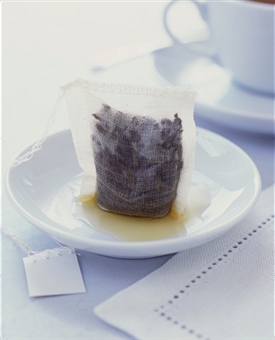
Used teabag-gettyimages
I found my item at my own table:
The teabag, drained of its energy, slouched in a dark pool of tears. It knew its destiny, and the trashcan, was near.
People felt sorry for my teabag. I hesitated tossing it into the trashcan after class.
On Friday, I’ll return with more from Sonya Sones and her other secrets to make your prose prance.




 alvaradofrazier.com