Rejection letters can knock you on your butt. And that’s okay, it happens, stuff hurts, rejection sucks. But you can’t stay on the floor, rubbing your a**.
1. Get your butt off the floor and go do something nice for yourself. Take a walk, draw, watch a comedy, play with your kids or pet. This includes eating or drinking-5 minute limit. Put on the timer.
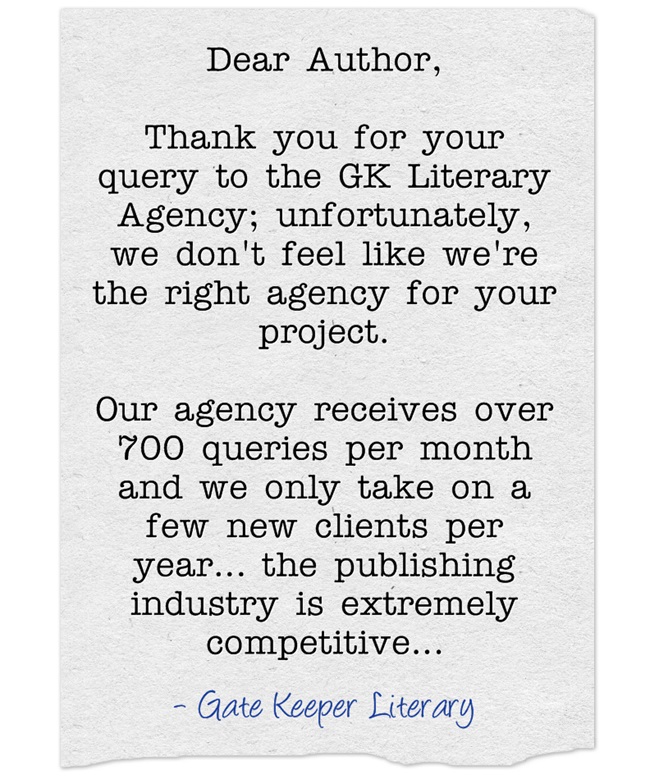
After 30+ ‘thank you, but no thank you’ emails on one manuscript and going on 20 for another, I’ve numbed out when I begin reading text that begins with “Dear Author.” (As I type, I swear another ‘Dear Author’ email blurb popped up on my screen).
Mona AlvaradoFrazier-Dear Author
2. Don’t stuff your feelings. I usually say, “Ah, crap,” or “Pftttt.” Sometimes I whine, “I’m never going to get published….” You can ‘wau-wau’ ‘boo-boo,’ but only for five minutes-again, put on the timer.
3. Think of the ‘no thank you,’ like James Lee Burke (his novels have been made into films):
“Every rejection is incremental payment on your dues that in some way will be translated back into your work.”
—James Lee Burke
I’ve also had many more emails that begin with my actual name and say some nice things before the ‘NO’ comes. The agent tries to soften the blow. Bless his/her little heart.
4. With each rejection, I file the email in my little folder and then I either re-read the MS, or ask my writing sisters for more critique. Keep trying.
Twice, out of 50+ times, I’ve had what felt like B-12 shots to the heart.
“I’d love to read more, please send the entire manuscript…”
Six weeks later I get another type of shot, one in the butt.
“After careful consideration….Uh, no.” Well that’s not entirely true. One rejection felt like that while the other was thoughtful.
5. If someone gives you specific criticism, regard it as a gift. Let them know you appreciate their comments.
This agent took the time to explain why she didn’t accept the MS. She supplied some examples, some suggestions, all in a couple of paragraphs. I felt respected, overjoyed, and then grateful.
I shared the agents comments with my writing sisters. They were happy for me. Why? Because I know, we know, that I am much farther along the road to getting an acceptance than I once thought. I’m going to work on those weak areas for the next month or until I get it right.
“An absolutely necessary part of a writer’s equipment, almost as necessary as talent, is the ability to stand up under punishment, both the punishment the world hands out and the punishment he inflicts upon himself.”
—Irwin Shaw
Rejection letters are part of the process of writing. That’s just the way it is, for writers, for everybody. It takes a strong woman/man, a bien chingona to keep writing pass the hill of rejection letters.
6. Turn your rejection around and see what you can gain. Go get the timer again. Shut off your computer. Now, write out your feelings, huff and puff, or boo-hoo on paper. Rip it to shreds if you want. Slam dunk it into the wastebasket. Or put it away for when you need that kind of emotion in one of your stories or poems.
7. Keep growing. Attend a critique group. Enroll in online or offline classes. Keep reading. Attend at least one conference a year. Spend more time on your writing work than on social media. (You can devote more time to that area after you’re published).
Jimmy Santiago Baca, an award-winning writer and poet (National Endowment of Poetry Award) does it again. Singing At The Gates is a collection of new and previously published poems that reflect back over four decades of Baca’s life.
This selection of poems includes his early work as a budding poet, written while he was 18 years old and serving a five-year prison sentence, poems drawn from his first chapbook and recent pieces on family, nature and the environment.
“What an achingly beautiful collection this is. So split open, so raw, honest, vulnerable, real. Spanning Baca’s life in poetry, you feel the enormity of his heart and intelligence.” —Natalie Goldberg, Writing Down the Bones and The True Secret of Writing
When I read poetry, it’s usually two or three poems at a time. I’m partial to shorter narrative poems that are rich with description and weighty with a single word. My favorite poets are mainly women but sometimes I’m drawn to a poem by a male poet such as Jimmy Santiago Baca.
Baca’s voice captured me at his introduction and I didn’t want to stop reading until I was exhausted.
“I love the growl of poetry, the staggering crash of idols and the burning of literary pacifiers…writing was for me, everyday-me snatching memories and writing them down before the fire of forgetfulness and trauma relegated them to the dark chambers of amnesia…I take only what I can carry and what is most meaningful to me-and that is the narrative, the story, the poem.”
The rawness and vulnerability that Baca writes about in the first half of the collection is so heavy, at times, that my emotional exhaustion came after five or six poems. Many of the poems are viscerally descriptive:
“I wear the moon like yanked out roots
glowing orange
in my heart’s fang as I search for secrets
in my life”
Approximately halfway in the collection we come to poems of awakening, growth, family and celebration.
“The reason I wake this morning
is because those people who’ve lived
through tragedies and loneliness and
anxiety found in their shattered-pottery
hearts fragments that fit perfectly
into the puzzle of night stars,
into the joyous cry
of a child at dawn
dashing out on the playground,
into the hands of men like me
who rise and dress and walk
out the door, culling from winter night
residues of summer
to dream a bit more
of the growing season.”
The last third of the collection is from 1998 to present. In Baca’s poem “It Makes Sense To Me Know,” he writes about his time as a volunteer teacher of reading and writing. He asks the children to write a letter poem about their journey to America and describes a shy little girl asking him to sit on the floor next to her as she stood on a small stage in a bookstore.
“When she uttered that first word/a glint of light sparked across her brown eyes into the world, as if it were/golden/speech without sound. I sat amazed/at the light in her eyes, igniting a memory/in/me–when/I too recited my first poem. The intensity/and/radiance of/a child reaffirmed my original reason for/writing, one I had forgotten along the way./Suddenly/I knew, keeping the light intact,/not teaching writing, not to mold or direct,/just to keep it burning, blowing on the /embers so hope doesn’t go out…”
I cannot name one favorite poem but I have a top ten list of Baca’s poems because there are so many touching, gripping, slap you upside the head words of poetry in this 254 page collection (for Kindle).
Singing at the Gates debuts in January 2014 but is available for pre-order through Amazon, Barnes and Noble, and other bookstores. I read the collection as a participant of NetGalley.



 alvaradofrazier.com