Rejection letters can knock you on your butt. And that’s okay, it happens, stuff hurts, rejection sucks. But you can’t stay on the floor, rubbing your a**.
1. Get your butt off the floor and go do something nice for yourself. Take a walk, draw, watch a comedy, play with your kids or pet. This includes eating or drinking-5 minute limit. Put on the timer.
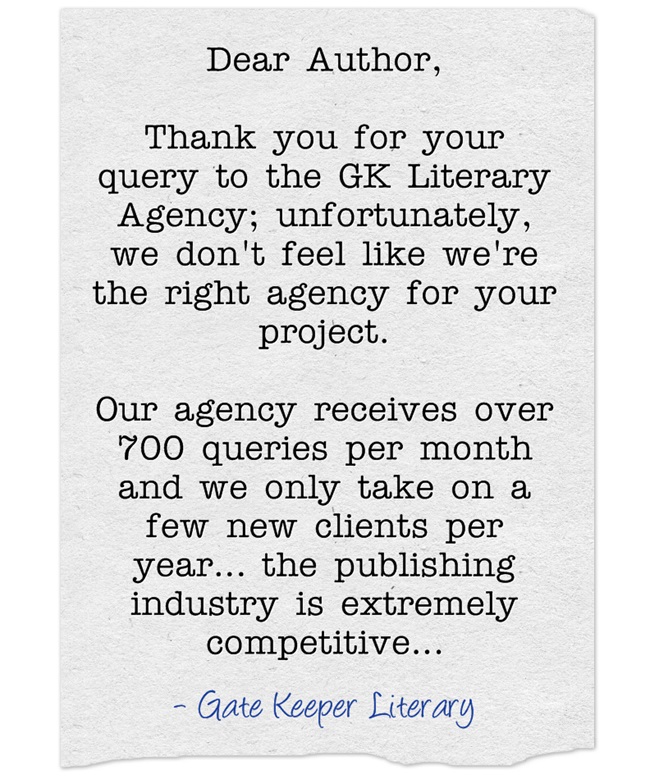
After 30+ ‘thank you, but no thank you’ emails on one manuscript and going on 20 for another, I’ve numbed out when I begin reading text that begins with “Dear Author.” (As I type, I swear another ‘Dear Author’ email blurb popped up on my screen).
Mona AlvaradoFrazier-Dear Author
2. Don’t stuff your feelings. I usually say, “Ah, crap,” or “Pftttt.” Sometimes I whine, “I’m never going to get published….” You can ‘wau-wau’ ‘boo-boo,’ but only for five minutes-again, put on the timer.
3. Think of the ‘no thank you,’ like James Lee Burke (his novels have been made into films):
“Every rejection is incremental payment on your dues that in some way will be translated back into your work.”
—James Lee Burke
I’ve also had many more emails that begin with my actual name and say some nice things before the ‘NO’ comes. The agent tries to soften the blow. Bless his/her little heart.
4. With each rejection, I file the email in my little folder and then I either re-read the MS, or ask my writing sisters for more critique. Keep trying.
Twice, out of 50+ times, I’ve had what felt like B-12 shots to the heart.
“I’d love to read more, please send the entire manuscript…”
Six weeks later I get another type of shot, one in the butt.
“After careful consideration….Uh, no.” Well that’s not entirely true. One rejection felt like that while the other was thoughtful.
5. If someone gives you specific criticism, regard it as a gift. Let them know you appreciate their comments.
This agent took the time to explain why she didn’t accept the MS. She supplied some examples, some suggestions, all in a couple of paragraphs. I felt respected, overjoyed, and then grateful.
I shared the agents comments with my writing sisters. They were happy for me. Why? Because I know, we know, that I am much farther along the road to getting an acceptance than I once thought. I’m going to work on those weak areas for the next month or until I get it right.
“An absolutely necessary part of a writer’s equipment, almost as necessary as talent, is the ability to stand up under punishment, both the punishment the world hands out and the punishment he inflicts upon himself.”
—Irwin Shaw
Rejection letters are part of the process of writing. That’s just the way it is, for writers, for everybody. It takes a strong woman/man, a bien chingona to keep writing pass the hill of rejection letters.
6. Turn your rejection around and see what you can gain. Go get the timer again. Shut off your computer. Now, write out your feelings, huff and puff, or boo-hoo on paper. Rip it to shreds if you want. Slam dunk it into the wastebasket. Or put it away for when you need that kind of emotion in one of your stories or poems.
7. Keep growing. Attend a critique group. Enroll in online or offline classes. Keep reading. Attend at least one conference a year. Spend more time on your writing work than on social media. (You can devote more time to that area after you’re published).
My cell phone screen saver has the dramatic backdrop of the mountains and mesas surrounding Ghost Ranch, just to cheer me up. I still have the AROHO retreat on the mind and the spirit of the women I met in my heart.
These women are “chingonas” “strong women,” in my book. They’re not strong because they were born that way, or Superwomen, but rather they became strong through failure, weakness, trials, and experiences that would defeat many. They learned from these challenges, gathered knowledge along the way, and shared that wisdom with others. That’s what makes them “chingonas.”
What I learned through these women helps me touch my AROHO experience and I hope assists you in some small way.
Each day we chose to attend 15 minute “Mind Stretches.” These were discussions on topics exploring craft, creative process, issues personal to women and publishing. Several of my past posts had to do with the craft of writing, such as Writing on the Edge but today’s post is about publishing.
“You think finding the right partner is a problem? Try finding the right publisher.” Kate Gale
This quote gives you a little insight into the witty personality and honesty of Kate Gale, PhD. She is Managing Editor of Red Hen Press, Editor of the Los Angeles Review , Past President of PEN and President of the American Composers Forum, LA. She serves on the boards of A Room of Her Own Foundation and Poetry Society of America. She is author of five books of poetry and six librettos including Rio de Sangre, with composer Don Davis.
Kate Gale-Writer, Poet, Publisher
Kate’s bio shows us that the woman knows what she’s talking about when it involves writers, poets, and publishing. Her insights into the world of writers is priceless:
“…the most difficult part in getting one’s work out into the world is that you are a cave dweller if you are a writer. You have to come out of your cave, understand the world of editing, publishing, publicity, social media, and you have to talk to people. And you don’t know how. So you go back into the cave angry. And emerge later. Telling people how you aren’t appreciated. That doesn’t make them love you more. You start to seem misanthropic. Writers can be fun. Funny and fun. There is a lot you can learn from writers. About patience mostly.”
Now go grab a pen and notebook, it’s time for some interactive work to help you find the right publisher.
Answers these five questions:
Who are you? Come on you can list more than three items. What are you passionate about? Keep writing until you get to the heart of you.
What does your story (novel, memoir, poem) want to say? What is your message? Keep writing until you find some universal themes.
Who are the writers in your tribe (genre of writing)?
List 5-10 writers you love to read in your genre of writing (most of them have to had published in the last five years). Let’s say the writers/books you write about and love are in the historical fiction genre. Now:
What regional, national associations in this genre do you belong to?
Have you attended conferences, workshops, seminars in this genre?
Do you attend readings in this genre?
4. Once you find your tribe (in #3), you need to find out how to open and get inside that door. The people you meet should be part of the tribe.
5. Form connections with authors, editors, agents, publishers you meet in these settings.
Meet them one on one. Step out of your comfort zone.
Let them know how much their reading, presentation, or book meant to you.
Once inside the door, make yourself useful. Volunteer, hold an office, contribute in some way. Be a literary citizen.
Did you fill up at least one side of your paper? If you did, you’re on your way to finding the right publisher for your work. It’s a difficult road to walk as a writer, but with guidance it may be a whole lot easier. Happy travels and happier writing.




 alvaradofrazier.com