Rejection letters can knock you on your butt. And that’s okay, it happens, stuff hurts, rejection sucks. But you can’t stay on the floor, rubbing your a**.
1. Get your butt off the floor and go do something nice for yourself. Take a walk, draw, watch a comedy, play with your kids or pet. This includes eating or drinking-5 minute limit. Put on the timer.
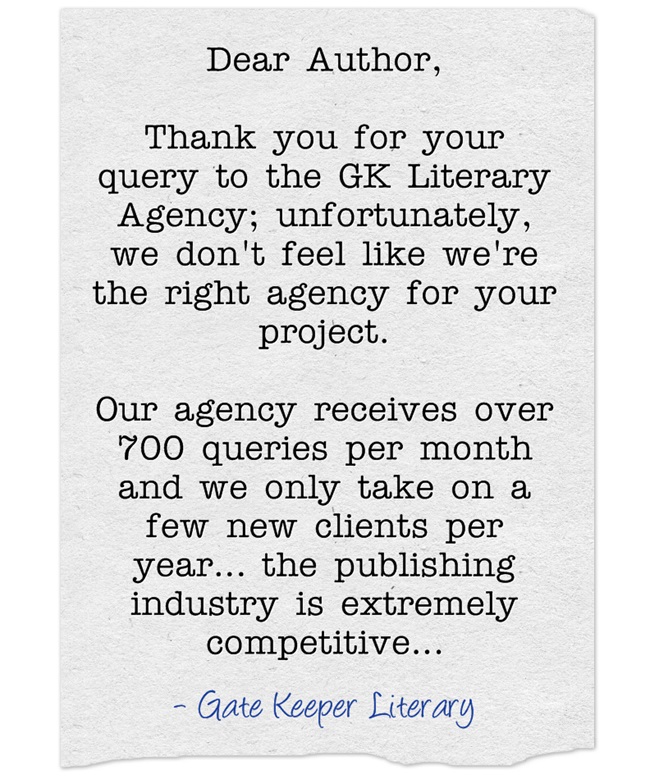
After 30+ ‘thank you, but no thank you’ emails on one manuscript and going on 20 for another, I’ve numbed out when I begin reading text that begins with “Dear Author.” (As I type, I swear another ‘Dear Author’ email blurb popped up on my screen).
Mona AlvaradoFrazier-Dear Author
2. Don’t stuff your feelings. I usually say, “Ah, crap,” or “Pftttt.” Sometimes I whine, “I’m never going to get published….” You can ‘wau-wau’ ‘boo-boo,’ but only for five minutes-again, put on the timer.
3. Think of the ‘no thank you,’ like James Lee Burke (his novels have been made into films):
“Every rejection is incremental payment on your dues that in some way will be translated back into your work.”
—James Lee Burke
I’ve also had many more emails that begin with my actual name and say some nice things before the ‘NO’ comes. The agent tries to soften the blow. Bless his/her little heart.
4. With each rejection, I file the email in my little folder and then I either re-read the MS, or ask my writing sisters for more critique. Keep trying.
Twice, out of 50+ times, I’ve had what felt like B-12 shots to the heart.
“I’d love to read more, please send the entire manuscript…”
Six weeks later I get another type of shot, one in the butt.
“After careful consideration….Uh, no.” Well that’s not entirely true. One rejection felt like that while the other was thoughtful.
5. If someone gives you specific criticism, regard it as a gift. Let them know you appreciate their comments.
This agent took the time to explain why she didn’t accept the MS. She supplied some examples, some suggestions, all in a couple of paragraphs. I felt respected, overjoyed, and then grateful.
I shared the agents comments with my writing sisters. They were happy for me. Why? Because I know, we know, that I am much farther along the road to getting an acceptance than I once thought. I’m going to work on those weak areas for the next month or until I get it right.
“An absolutely necessary part of a writer’s equipment, almost as necessary as talent, is the ability to stand up under punishment, both the punishment the world hands out and the punishment he inflicts upon himself.”
—Irwin Shaw
Rejection letters are part of the process of writing. That’s just the way it is, for writers, for everybody. It takes a strong woman/man, a bien chingona to keep writing pass the hill of rejection letters.
6. Turn your rejection around and see what you can gain. Go get the timer again. Shut off your computer. Now, write out your feelings, huff and puff, or boo-hoo on paper. Rip it to shreds if you want. Slam dunk it into the wastebasket. Or put it away for when you need that kind of emotion in one of your stories or poems.
7. Keep growing. Attend a critique group. Enroll in online or offline classes. Keep reading. Attend at least one conference a year. Spend more time on your writing work than on social media. (You can devote more time to that area after you’re published).
Ever since I figured out how to use the Goodreads widget I’ve been posting reviews on books I’ve read.
Either the widget is dead, malfunctioning or my brain is on overdrive and I’ve forgotten how to use the darn thing, but the widget is not working. Hence, here are reviews on the two latest books I’ve enjoyed in the last month.
América by Esmeralda Santiago
América Gonzalez is a hotel maid at an island resort off the coast of Puerto Rico. She cleans up after wealthy foreigners who look past her as a non-entity. Her married boyfriend, Correa, beats her and their fourteen-year-old daughter thinks life would be better anywhere but with América. When a wealthy, too busy, family asks her to work for them in the United States, América plans her escape from Correa and her old life.
Domestic violence, family dynamics, fear, and choices are themes in this novel. The ongoing violence that América endures is sometimes difficult to read. One feels like yelling at her to drop the bastard and make better decisions, however the author illustrates that this is no easy task.
Reading about a character who makes poor choices can often be a turn-off, however the author engages the reader by describing the protagonist and her backstory effectively.
Beautiful descriptive prose keeps you reading but the redundant descriptions on setting is sometimes too much and the eye wants to scan for the forward movement in the story.
I love the dialogue, the emotional reactions, and interplay between the maids. I loved how the author gave us the dialogue between the mother and protagonist. The villain in the story was well played.I learned some things about Puerto Rico, the culture and language which is a plus in my opinion.
I didn’t like the way the daughter’s character was written. She had the same extremes of reaction over the entire book.
These glitches may be because this is the author’s first novel (1996). I would definitely read Esmeralda Santiago’s other books.
One Man Tango by Anthony Quinn and Daniel Paisner
Description from publisher:
“While bicycling near his villa in Ceccina, Italy, veteran actor Anthony Quinn begins a remarkable journey of self-discovery through a varied and colorful past–and delivers one of the most fascinating star biographies ever written. Resonating with Quinn’s own passionate voice, an infectious zest for living, and a wealth of juicy anecdotes, One Man Tango is by turns resilient and caustic, daring and profound. It is a memoir as bold as the man who wrote it. Includes a 16-page photo insert. HC: HarperCollins.”
Anthony Quinn was a hero of many Latino’s, being that he was a well known actor in the ’40-’70’s when few Latinos were on the big screen. Not only did he come from Mexico, but he grew up in East Los Angeles. He was associated with the Kennedy’s, Catholics, Cesar Chavez, laborers, and California politics which further endeared him to the Mexican American community.
I couldn’t help loving this book.When I read the memoir it was as if Anthony Quinn himself was in my family room recounting his memories. He lived as passionately as his many love affairs.
Remember Zorba the Greek? Well, Anthony Quinn had that enthusiasm for living. His early life was one of extreme poverty in Mexico, with his Mexican Irish father who fought in the Mexican Revolution, and his Mexican Indian mother.
The memoir is as fast paced as his bicycle ride through the hills of Ceccina, giving the reader an insight into the hills and valleys of the actor’s life, which is fascinating. Besides being an actor he was a laborer, boxer, artist, vintner, writer and philanthropist.
His memory of the movie stars, producers, and directors that he worked with is fascinating, juicy and very entertaining. He worked with Marlon Brando, Laurence Olivier, Mickey Rooney, Carole Lombard, Maureen O’Hara, Rita Hayworth, and numerous other memorable actors. His memoir reads like a Who’s Who of Hollywood and the world, with all the side dishes that go along with these characters.
Particularly interesting was his experiences and conflicts with mobsters, politicians, and movie moguls, including his father-in-law, Cecil B. De Mille. Their family dynamics were extremely interesting.
Anthony Quinn often reminisces about his poor choices, the emotional turmoil he put his wife and family through, and looking back it seems he regrets some of his decisions. But what also comes through the memoir is that he loved his family like a ferocious lion.
This memoir is one of the most well-written, insightful, and candid story I’ve ever read. There are many beautifully written phrases and visuals that make you feel you are on that bicycle ride through the towns and cities of Mexico, East Los Angeles, Hollywood, and Italy.
as Eufemio Zapata with Marlon Brando’s Emiliano Zapata in Viva Zapata! (1952) (Photo credit: Wikipedia)




 alvaradofrazier.com