Rejection letters can knock you on your butt. And that’s okay, it happens, stuff hurts, rejection sucks. But you can’t stay on the floor, rubbing your a**.
1. Get your butt off the floor and go do something nice for yourself. Take a walk, draw, watch a comedy, play with your kids or pet. This includes eating or drinking-5 minute limit. Put on the timer.
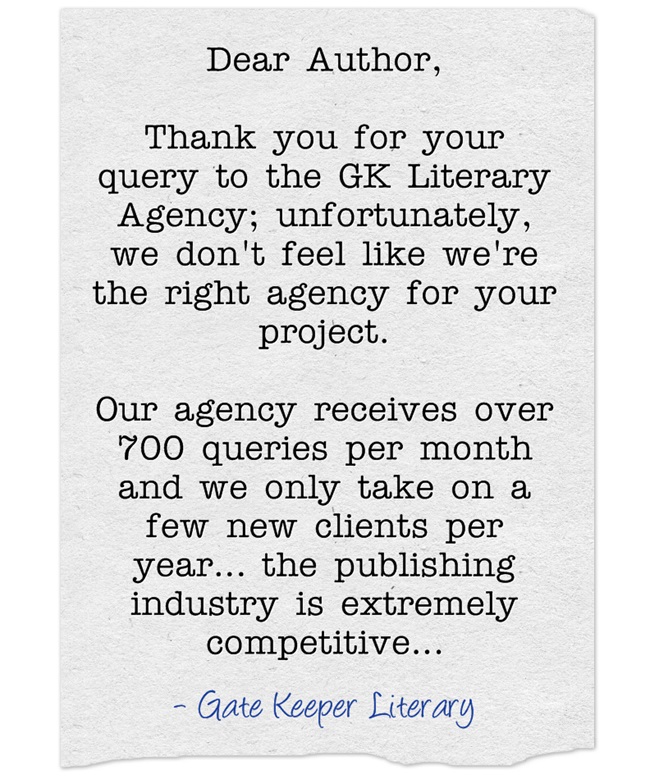
After 30+ ‘thank you, but no thank you’ emails on one manuscript and going on 20 for another, I’ve numbed out when I begin reading text that begins with “Dear Author.” (As I type, I swear another ‘Dear Author’ email blurb popped up on my screen).
Mona AlvaradoFrazier-Dear Author
2. Don’t stuff your feelings. I usually say, “Ah, crap,” or “Pftttt.” Sometimes I whine, “I’m never going to get published….” You can ‘wau-wau’ ‘boo-boo,’ but only for five minutes-again, put on the timer.
3. Think of the ‘no thank you,’ like James Lee Burke (his novels have been made into films):
“Every rejection is incremental payment on your dues that in some way will be translated back into your work.”
—James Lee Burke
I’ve also had many more emails that begin with my actual name and say some nice things before the ‘NO’ comes. The agent tries to soften the blow. Bless his/her little heart.
4. With each rejection, I file the email in my little folder and then I either re-read the MS, or ask my writing sisters for more critique. Keep trying.
Twice, out of 50+ times, I’ve had what felt like B-12 shots to the heart.
“I’d love to read more, please send the entire manuscript…”
Six weeks later I get another type of shot, one in the butt.
“After careful consideration….Uh, no.” Well that’s not entirely true. One rejection felt like that while the other was thoughtful.
5. If someone gives you specific criticism, regard it as a gift. Let them know you appreciate their comments.
This agent took the time to explain why she didn’t accept the MS. She supplied some examples, some suggestions, all in a couple of paragraphs. I felt respected, overjoyed, and then grateful.
I shared the agents comments with my writing sisters. They were happy for me. Why? Because I know, we know, that I am much farther along the road to getting an acceptance than I once thought. I’m going to work on those weak areas for the next month or until I get it right.
“An absolutely necessary part of a writer’s equipment, almost as necessary as talent, is the ability to stand up under punishment, both the punishment the world hands out and the punishment he inflicts upon himself.”
—Irwin Shaw
Rejection letters are part of the process of writing. That’s just the way it is, for writers, for everybody. It takes a strong woman/man, a bien chingona to keep writing pass the hill of rejection letters.
6. Turn your rejection around and see what you can gain. Go get the timer again. Shut off your computer. Now, write out your feelings, huff and puff, or boo-hoo on paper. Rip it to shreds if you want. Slam dunk it into the wastebasket. Or put it away for when you need that kind of emotion in one of your stories or poems.
7. Keep growing. Attend a critique group. Enroll in online or offline classes. Keep reading. Attend at least one conference a year. Spend more time on your writing work than on social media. (You can devote more time to that area after you’re published).
Five months ago I thought I was ready to jump in and send out query letters for a manuscript I thought I had completed. Doesn’t ten revisions and your critique groups nod of approval mean your MS is ready? NO. The MS was not ready, and neither was the query letter. If I had followed my “hindsight is 20/20” advice and utilized the five tools after writing “The End,” I would have saved myself months of time, the rejection letter depression, and needless work. But that’s all in the past and that experience is lessons learned for the future. In the last post I covered the first four suggestions to get your manuscript ready. (Disclaimer: these suggestions are based on my own experience). The fifth tool to implement in revising your manuscript is finding a professional editor for your work.
123rf.com
This can be like looking for that proverbial needle in a haystack. You can shift through 25 million Google results, that you’ll receive 44 seconds after pressing ‘enter,’ or you can use another plan of shifting through the abyss of results. Before you start your search, decide on what type of editing you want for your MS and your budget. Do you want a developmental editor to tell you where you have plot holes, where to revise, critique your characters, help your flow? Do you want pages of notes, chapter by chapter? Or do you want a line/copy editing, where the editor addresses grammar and style but not the structure of the book, the voice or tone.
Are you willing and able to spend $500, $1000, or $2,000+ for an editor. If you can’t afford this perhaps sending in 100 pages of your novel will suffice and the editor’s comments can lead you in the right direction. I decided on hiring a developmental editor. I wanted notes on plot structure, pacing, characters, and suggestions for revision. My budget was $1000. After you’ve answered the above questions, you can start your search for a professional editor. Here is where I looked:
Agents who blog– I follow Rachelle Gardners blog and found this list of freelance editors. Find which ones seem appropriate for the job.
Genre freelance editors– Editors specialize. Use your search engine to find a freelance editor in your genre, i.e Christian Historical Fiction freelance editor. Under that search ‘only’ 1 million results are returned (just go to the first five or 10 names and research).
Ask a writer-On Facebook I follow several writers whose books I really enjoy. I picked three of them, who write in similar genres, and asked them who their editor was or if they could suggest an editor.
I thought the last one, ‘ask a writer,’ was a long shot, but this is how I found my editor, an author of three novels (two award winning), an MFA college instructor in creative writing, and who knew, but she is a freelance editor also. On her author page she listed her services.
In less than a week the author/editor agreed, in writing, on what I wanted from the developmental edit, the price, and the turn around time. Half of the price was upfront and the other half on completion. After the edit I could also meet with her for an hour to discuss, in person or via phone, the edited MS. Luckily she was an hour away from my home town so I availed myself of this consultation.
Three weeks later I received three typed pages of comments on Character Development for each character, Plot/Structure, Conflict, Descriptions, Pacing, and Voice.
This was followed by 18 page by page, chapter by chapter notes. On 240 pages of MS there were notes in the margins, questions or highlights on some prose she thought was poignant or well stated. We met in person soon after, and she answered the questions I had.
Two months later I finished the revisions. I felt so good about the work I decided to apply for a writing fellowship for the writing retreat sponsored by A Room Of Her Own, AROHO.
Part of the application was to send in the first 10 pages of your manuscript. I did and was accepted. Here’s my mug and a rambling bio (rambling because I was still stupified) on the AROHO “Participating Writers” page. I’m in awe of the company in which I share the page.
With the AROHO acceptance I decided that it was time to revise my query letter again (eighth time), and I sent 10 queries out. Within three days I received a request for a full manuscript. Yup, I was jazzed and stupified now.
Alas, three weeks later I received the rejection letter from the agent. After reading the MS she decided she wasn’t the agent for the work. I felt like the girl who was asked out by her crush, the date made, no phone call, then the “it’s not you, it’s me,” line.
But no boo-hoo’s here. Back to butt in chair.
It’s time to gather up another 10-20 agent names and send out another batch of query letters.
If you have any suggestions to add to this list, please feel free to tell us about your recommendations.




 alvaradofrazier.com