Blog

Mexican traditions, Mother's Day, Mothers

11 Things My Mom Taught Me Without Knowing


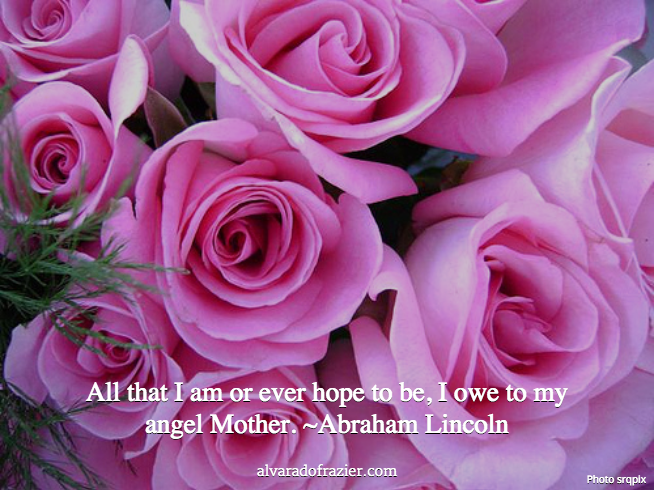
Lincoln quote on mothers

The other day I saw a contest, sponsored by the Santa Barbara Writer’s Conference. For a chance to win a free pass, one could enter a 500-word essay on the topic, “What my mother taught me.” The deadline was within a couple of days, so I passed on the opportunity, but the topic stirred my thoughts.

I began to think about my first generation mother an orphan of Mexican parents who came to the U.S during the Mexican Revolution. She taught me a lifetime of lessons, many which she probably isn’t aware of.

So, in tribute to Mother’s Day and my mom, I have a few items to mention. Some of which you might find unusual, but in many Mexican households, not so uncommon.

My mom taught me to:

  1. Appreciate Mariachi music, the old classics, where buried pain could be unleashed in the drama of the song. She also taught me how to give a ‘grito,‘ a shout to punctuate the parts of the song that called for emphasis or which resonated with the listener.
  2. Value hard work. As young teens, all of us picked walnuts, tomatoes, or strawberries on weekends to earn money to survive. We heard many a story about her picking cotton until her arms and fingers bled, the scorching vineyards and lettuce fields. The moral of the story: You do what you got to do. She survived and we would too.
  3. Value education unless you want to live your life in the fields. This is almost a direct quote we heard many times. Mom was in her 40’s, a single parent of four kids, who worked full time and went to college at night during the late 60’s. By the early 70’s she earned two Bachelor’s degrees.
  4. Cook basic Mexican food and be creative with the welfare commodities. We learned how to make a guisado, beans de olla, tortillas (even though mine looked like the map of Texas), and nopales. We also made Spam and powdered eggs with chile, Mac and cheese, and grits.
  5. Use nature’s and grocery store remedies. For a cold, use Vapor Rub and put your socks on. For a tummy ache, use the Yerba Buena that grew under our front yard faucet. For nausea, drink 7Up. For a flu, use all three and bury yourself under the blankets.
  6. Duck, dive, and discipline. Mom had a baseball arm and threw her chancla (house slipper) when she’d had it with us. I swear that thing seemed like a magic boomerang. She didn’t spank us, at least not me and my sisters, but that threat of a nalgada kept us in line. Sometimes. All she had to do was flip her chancla off and we’d start running. Same thing as hearing her say, “Where’s my belt?” although she didn’t have one.
  7. Exercise starts at home. Mom won dance contests as a young woman. Trophies, cash money, and during WW II, she won a pig. Chicharrones for days! She still dances between her TV shows for exercise and cares for 30+ rose trees, fruit trees, and numerous potted plants.
  8. Self-defense. Mom was her older brothers sparring partner as a kid. I’ve seen her fight, many years ago and in self-defense, and she’s good. She often shadow boxed with us as kids. I do it with my own. It’s play boxing, never to draw blood, except this one time when my sisters jumped me for a jelly donut (true story).
  9. The value of family. As children, we regularly visited extended family, spending holidays and Sundays together. Now all my aunts and uncles on my mom’s side have passed on. Only she remains. My cousins and their children are still in her life.
  10. The enjoyment of books. I often remember her stories of reading up in her Elm tree in front of her house. After she was orphaned she’d spend hours away from her aunt and uncle, sitting on a tree branch reading a library book. Books filled our home early in our life. My first introduction to feminism, politics, Mexican and Chicano History came from her college texts.
  11. Faith. Growing up, I regularly saw my mom pray. We had a small altar under our staircase in our home. Glowing votives, saints, the works. She believed things would turn out, even when everything around us didn’t seem to be working out.

Happy Mother’s Day! Now, what did your mother teach you?


Encouragement, writer routines, Writer's Digest, Writing, writing conferences, Writing groups

Writing Communities

Hemingway quote on writing
Born or Learned? http://www.alvaradofrazier.com


Hemingway’s quote settles the debate over whether people are born writers or if writing can be taught. Whether you’re a natural at writing or not, everyone has to work to improve their ability.

Three years ago, I participated in the Platform Challenge, given by Robert Lee Brewer, from Writer’s Digest who described himself as a poet, editor, and happy smack talker. The latter captured my interest and I joined.

Our challenge was to try a different tool, process or form of social media every day in order to build an online platform. Over 300 writers formed around that challenge and when it was over, most of the group banded together and founded Wordsmith Studio, a community of writers, of which I’m a founding member.

Many of the members are now published authors, poets, editors, book reviewers, and all around lovely writers. I’ve met so many writers who have brought me stories and poems that delighted, inspired or gave me a new perspective on a subject.

To commemorate our three-year anniversary, we are catching up with group members who are spread all over the nation by using writing prompts as a means of checking in with one another and celebrating our three-year anniversary with a blog hop.

This week’s prompt is to share our challenges and successes, to reflect on skills, tools or resources that helped us find success. And by success, I don’t mean I’m a published author with thousands of sales. Success means I’m improving, still writing stories, and sending out queries.

Now, on to the questions:

1) What are you currently working on? One of my YA manuscript’s (ms) is out in query stage after too many to count revisions and two editors (hey, it was my first novel). I’m having the hardest time with finding an agent to take on a ‘girl in prison’ story. 

The second one, Women’s Fiction, was given the once-over by an editor I met online who did a wonderful job. The third ms is on a hard drive. The fourth work in progress, a New Adult, is halfway completed.

2) For past work, what was your greatest joy or greatest challenge?

The best things that I’ve enjoyed is receiving a fellowship, twice, to A Room Of Her Own (AROHO) Foundation for their biannual writers retreat and accepted as a ‘mentee’ into the Association of Writers and Writing Programs (AWP) Mentorship three month program. My mentor is an author and creative writing professor at a university.

The other best thing is when people say great things about your writing. My AWP mentor’s encouraging words, “There are remarkable revisions in this ms…Juana’s story continues to grow with drama and emotion, with compelling lives and stories, …what strikes me from the very beginning are the beautiful and powerful images that (she) remembers, imagines, and culls from her life; images you compose with beauty and power.”

From my recent editor on the second ms: “Your (ms) opens with some of the most brilliant writing I have seen for some time. There is an air of literary style, coupled with a control of sentence structure that creates an atmosphere thick with emotion. Helpless, vulnerable, deeply hurt, but with a bit of hope and denial…” 

3) For current work, what challenge are you working through now? 

My goal is to revise the Women’s Fiction ms during May. Although my editor had great comments about the novel, there are many other not so good areas to fix.

4) What have successes or challenges in your work (recently) taught you?

Utilize all the help you can get. By that I mean go to at least one workshop or conference a year on writing craft. Participate in an going critique group. Online you can use Critique Circle. Be persistent, disciplined, and believe in what you’re doing. Writer’s have to be in it for the long haul-years, decades, not months.

Being a pantser did not work out for me. My first novel has taken years and numerous revisions because I did not know story structure. I will never be a plotter, but I have found that a loose outline helps tremendously. Study story structure. I like Larry Brooks’ blog from Storyfix.

I use too many commas, use the words ‘just,’ ‘even’ and ‘was.’ To help me with grammar, redundant words, and passives I bought a month of AutoCrit. I needed it so much that I ended up buying the editing service for a year. I also use Grammarly.

6) What obstacles or challenges have you not been able to overcome, or still frustrate you?

Writing query and synopsis letters is still the most frustrating and non-fun thing to do. I would like to outsource this work.

7) How would you describe a great writing day (or week)?

Writing in my pajamas, with fresh hot coffee at my side, glancing at the flowers on my patio once in a while, and finishing what I set out to do that morning makes me feel satisfied. Taking a walk in the late afternoon and reading an absorbing book tops off a great writing day.

And in the words of Winston Churchill:

winston-c


If you are from the Wordsmith community, stop by and click a ‘Like,’ subscribe, or say hello in the comments. Thanks for reading and have a fun weekend.