Family, Latino culture, Latino Family Traditions, Parenting

How Tamales Make My World A Better Place

Ingredients for making 'Green' Tamales
Ingredients for making ‘Green’ Tamales

Every December, I write about making tamales, and this year is no different.  Our mother has made tamales for over seventy years, longer than her children have been alive. And her mother made tamales before she was born. And her mother, back to the days of maize and metates.

Something is wrong with my universe if our family stopped making Christmas Tamales. Our world can be is disarray, but we come together, three or four generations of our family and spend an entire day making tamales.

Keeping our tradition alive is like maintaining a bridge beginning in the past crossing to the present and spanning into our future. It’s family represented with food.

The name tamale comes from the Nahuatl (Aztec) word ‘tamalli,’ meaning ‘wrapped.’ The masa (maize) for the tamales come from our indigenous roots and have names from our ancestor’s primary language (Spanish/Nahuatl). Making tamales, for me, is maintaining our culture.

In the past, I’ve written about our Tamale Tactical Plan, The Five Important Ingredients for the Best Tamales, and the Tamales and Traditions post. Everything you wanted or didn’t want to know about tamales is in one of those posts.

This year four generations of our family donned our favorite aprons to make ‘green tamales’ or tamales de rajas. Right before Christmas we’ll make the ‘red tamales,’ or the red chile and pork tamales.

On our table, (picture above) in the twelve o’clock position is the masa preparada (prepared corn meal), at three o’clock, are strips of Ortega California green chile, at six o’clock, is more masa, at eight o’clock, is shredded Monterrey and Cheddar (a big mistake-use Monterrey only), at nine o’clock, is a pitcher of homemade chile, and in the center are the soaked corn husks, or ojas. We use a knife to spread the masa onto the oja; some people are adept with a spoon or a tamale spreader that looks like a cement masonry spreader. We are butterknife people.

Assembly line style, the five of us (four generations) spread the masa onto the oja and fill up every spot on the table. Two people stuff and fold the tamales. To get this important job you have to work your way up from tamale spreader to the stuffer.

This year, my eleven-year-old niece (representing the fourth generation) who graduated to tamale stuffer last year. You can see how proud she looks. She’s been helping since she was five years old. That’s her grandmother beside her (the second generation).
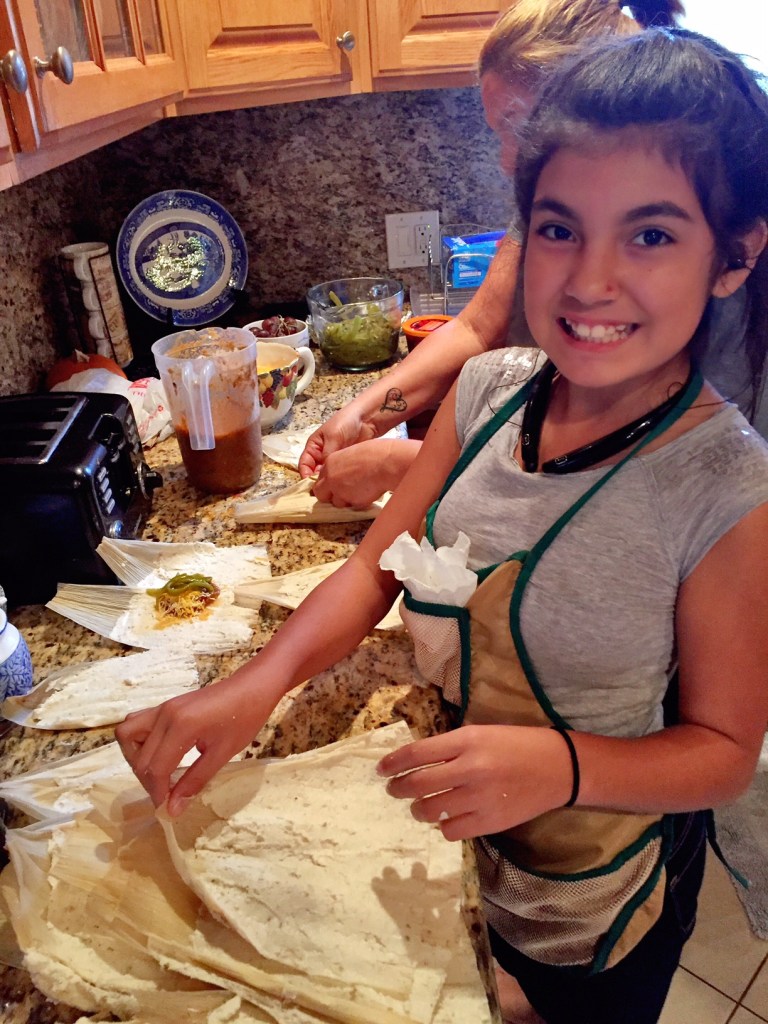
Corn husks with masa ready to be stuffed-www.alvaradofrazier.com
Corn husks with masa ready to be stuffed by the fourth generation-www.alvaradofrazier.com

I remember when her mother was five and helped spread masa on the corn husks. Truthfully, she spread more on the table than on the ojas, but that’s how you learn. This is a picture of her now (she’s the third generation).

spreading tamale masa
Tamale Time with the third generation. http://www.alvaradofrazier.com

This is how traditions are carried on through the years, from the parents to the children. It’s one of the touchstones that ground us to this world. For us, it’s part of parenting.

My portion of the tamales is in the freezer, ready to make the trip to Denver for a snowy white Christmas. While I’m there, I’ll make tamales and carry on the tradition, with a vegan twist, with my son and daughter.

Many of you are from different cultures and places in the world. I’d love to know what traditional food you make during this time of year. If you have a link to a post you’ve written about your tradition, please include it in the comment section so we can visit your home and kitchen.

Thank you and enjoy the holiday season.


Healing, Latino culture, Loss, Mexican traditions, Writing

Do You Know How to Use a Curandera?

Mexican Seri Woman Crossing the Desert
Mexican Seri Woman Crossing the Desert photo by Gabriela Iturbides

Do you know how to naturally heal fright or trauma? No? More about susto later.

During the last two years, I’ve worked on a story about an ambitious twenty-one-year-old with a ten-year plan to become a State Senator who drops out of college because of a broken engagement. She meets a grandmother and granddaughter who are curanderas. Although she doesn’t believe in this Mexican tradition of healers she takes matters into her own hands and makes a love potion. When the wrong people, her mother, ex-fiancé and others, drink the potion and fall in love she has to discover an antidote. Her search takes her to Oaxaca, Mexico to meet a curandera who may be able to help her heal her susto and give her the correct potion to make things right.

city of Puebla, Mexico
Puebla, Oaxaca, Mexico photo by Russ Bowling, unsplash.com

When I was a kid, every mother knew of a local curandera. Using their services was normal. For centuries, the Mexican culture has had curanderasSome cultures may call these people shamans, or medicine men or women. Some people call them, incorrectly, witches. 

Curanderismo is a healing art and a curandera/o is a healer who uses herbs, ointments, massage, and cleansings to cure an illness and do spiritual and psychic healings. They and the community believe the curandera has a spiritual calling to heal. They are often descendants of other curanderas.

mayan, healer, maya
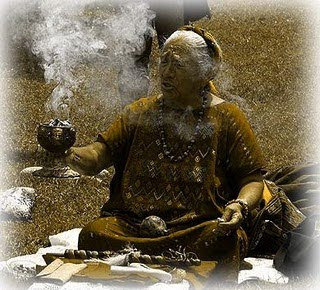
Margarita, Mayan Healer

The photo above shows a Mayan healer in Mexico. In the U.S, and my experience, the curanderas were usually grandmothers wearing aprons or elderly men in work clothes who conducted their ritual healings in their home or garage. Now they are more likely to work in a botanica which sells candles, oils, herbs, and other items such as amulets.

Using the services of a healer involved a small fee or a barter. This is probably why most Mexicans and Mexican Americans used a curandera. Either a doctor visit was too expensive, wasn’t available, or the doctor dismissed an ailment. Here’s a link to a doctor who discusses traditional remedies.  

But back to healing fright or susto. It seems there are degrees of susto. A person can be suffering a shock, an emotional trauma, or be in such a state of anxiety that they can’t function; which is the case with my main character in my novel in progress. When this happens, they are said to be suffering from susto.

A spiritual cleansing, limpia,  is often used by taking a bunch of selected herbs made into a small hand broom which is whacked across the entire body. This removes negative energy. After this, an egg is held above the head, moved around the body, and cracked open into a container which the curandera inspects. Why an egg? It is believed that an egg has the natural ability to absorb engergies around it. Finally, water is spit on the person. I know, sounds strange but this is what happens.

Curanderismo is not only a Mexican tradition but one that is found in most of Latin America and the Carribean. The subject is one that has fascinated me so much I had to write a novel (work-in-progress) featuring curanderas. Take a look at my storyboard for this novel. You may come across some interesting information.

Disclaimer: This post is not suggesting you use a curandera in lieu of a medical practitioner; that is your own decision.