Family, Family time, Mexican Cooking, Mexican Holiday food, Mexican Vegan food

Beginning a New Tradition with Tamales-Vegan Style!

Christmas Stars by J. De La Cruz, flickr.com cc

Five years after my youngest became a vegan, I now have another vegan son who has a wonderful girlfriend who is also vegan.

I began cooking vegan style for the youngest some time ago. My oldest son, David and his girlfriend, Laura ‘veganize’ all sorts of foods while educating people on their YouTube site titled “Hangry Vegans.” Their videos show their adventures shopping and creating vegan dishes. Recently, they created a Wix site, you guessed it: “Hangry Vegans.”

We made five types of tamales. And, this year I wasn’t the only one making vegan tamales. David and Laura sat at the table and learned from me and his aunt about the ‘how to’s” of making the masa (dough) and filling for tamales without lard or animal products.

They tried to manipulate the butter knife, masa to oja (corn husk) ratio, and fill the tamales without making them into fat burritos. I was impressed they kept at it, smoothing and fixing the ojas, laying on the right amount of chile and ‘cheese.’

A mother is impressed when her daughter cooks, but a Latina mother is doubly surprised when her adult son tackles a medium difficult project. For the trifecta, Laura said she and David would keep up the tradition. Maybe there will be some little ‘tamales’ in their future 🙂 (I’m going to get an OMG from them, but I’m joking!).

They both did well for first timers and now know why we complain of backaches the day after tamale making.

My mother stood by and asked what type of filling we’d use. When the words “Black beans” and vegan ‘cheese’ entered the conversation she gave us the familiar nose wrinkle. This is her polite way of saying “Yuck.”

You know millennials, they video everything. Here are the steps in motion:

Vegan Black Bean Tamales:

Masa/Dough

2 cups of Maseca Tamal corn flour
1 teaspoon baking powder
1 teaspoon salt

Mix together in a large bowl and add:
1 1/3 cup of vegetable broth

In another bowl, use
2/3 cup of coconut or vegetable shortening.
Mix until fluffy. Add this to the dry ingredients and stir until batter is smooth.
Knead the dough like bread until it’s smooth and slightly sticky.

You can also buy store-bought masa at a Mexican supermarket. Ask for masa sin preparada (not prepared with lard). To this masa add the vegetable shortening and knead.

Spread a thin to medium layer of masa on the oja/corn husk, leaving 1/4 from the top clear.

Add a tablespoon or more of drained and rinsed cooked black beans, shredded vegan Monterrey style Jack cheese, and diced green chiles or strips of chile. A teaspoon of salsa verde or salsa roja can also be added.

Fold each side of oja to the middle and fold over the top of the oja. Press the open ends of the oja gently together.

Take a deep pot (tamale) which has a steamer bottom or put an overturned foil pie pan with four ventilated holes at the bottom of the pot. Add water until it reaches the rim of the pie pan.

Stack tamales into the pot about 2/3 full and around the edges, leaving a small funnel in the middle. Or, you can basketweave the tamales around the edges, also with a funnel in the middle. Water, when needed, is added in this space.

Wet and wring out a clean cotton kitchen towel. Drape it over the top of the stacked tamales, put a lid on the pot and place on the stove, at medium heat. Add water when necessary.

Set a timer for 90 minutes. Use a potholder to lift the lid and check the tamales. The masa will be cooked solid if it’s done. If the masa is mushy, set the timer for another hour.

Any vegetable filling can be used: lentils and corn, spinach and vegan cheese, peas and carrots, butternut squash are some examples.

For our sweet tamales recipes: Pineapple, Coconut; Cinnamon Raisin; and Strawberry go over to Hangry Vegans website. Check them out, they’re so cute.

I have to say that, I’m a mom.

Merry Christmas and Happy Holidays!

Family, Latino culture, Latino Family Traditions, Parenting

How Tamales Make My World A Better Place

Ingredients for making 'Green' Tamales
Ingredients for making ‘Green’ Tamales

Every December, I write about making tamales, and this year is no different.  Our mother has made tamales for over seventy years, longer than her children have been alive. And her mother made tamales before she was born. And her mother, back to the days of maize and metates.

Something is wrong with my universe if our family stopped making Christmas Tamales. Our world can be is disarray, but we come together, three or four generations of our family and spend an entire day making tamales.

Keeping our tradition alive is like maintaining a bridge beginning in the past crossing to the present and spanning into our future. It’s family represented with food.

The name tamale comes from the Nahuatl (Aztec) word ‘tamalli,’ meaning ‘wrapped.’ The masa (maize) for the tamales come from our indigenous roots and have names from our ancestor’s primary language (Spanish/Nahuatl). Making tamales, for me, is maintaining our culture.

In the past, I’ve written about our Tamale Tactical Plan, The Five Important Ingredients for the Best Tamales, and the Tamales and Traditions post. Everything you wanted or didn’t want to know about tamales is in one of those posts.

This year four generations of our family donned our favorite aprons to make ‘green tamales’ or tamales de rajas. Right before Christmas we’ll make the ‘red tamales,’ or the red chile and pork tamales.

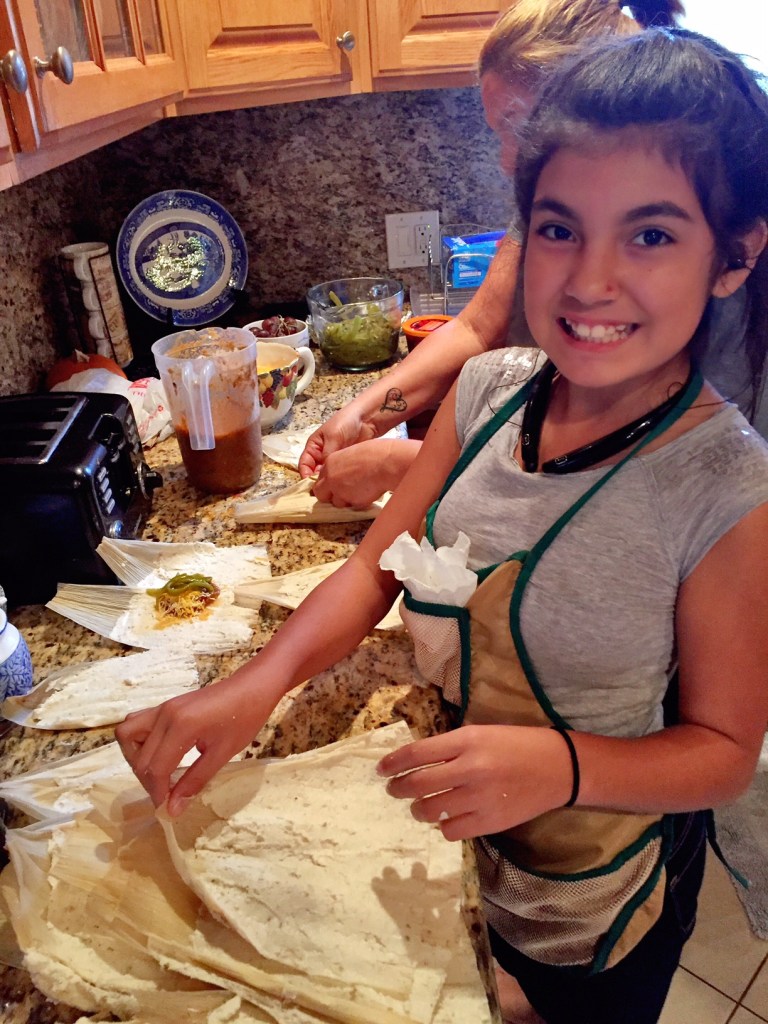
On our table, (picture above) in the twelve o’clock position is the masa preparada (prepared corn meal), at three o’clock, are strips of Ortega California green chile, at six o’clock, is more masa, at eight o’clock, is shredded Monterrey and Cheddar (a big mistake-use Monterrey only), at nine o’clock, is a pitcher of homemade chile, and in the center are the soaked corn husks, or ojas. We use a knife to spread the masa onto the oja; some people are adept with a spoon or a tamale spreader that looks like a cement masonry spreader. We are butterknife people.

Assembly line style, the five of us (four generations) spread the masa onto the oja and fill up every spot on the table. Two people stuff and fold the tamales. To get this important job you have to work your way up from tamale spreader to the stuffer.

This year, my eleven-year-old niece (representing the fourth generation) who graduated to tamale stuffer last year. You can see how proud she looks. She’s been helping since she was five years old. That’s her grandmother beside her (the second generation).

Corn husks with masa ready to be stuffed-www.alvaradofrazier.com
Corn husks with masa ready to be stuffed by the fourth generation-www.alvaradofrazier.com

I remember when her mother was five and helped spread masa on the corn husks. Truthfully, she spread more on the table than on the ojas, but that’s how you learn. This is a picture of her now (she’s the third generation).

spreading tamale masa
Tamale Time with the third generation. http://www.alvaradofrazier.com

This is how traditions are carried on through the years, from the parents to the children. It’s one of the touchstones that ground us to this world. For us, it’s part of parenting.

My portion of the tamales is in the freezer, ready to make the trip to Denver for a snowy white Christmas. While I’m there, I’ll make tamales and carry on the tradition, with a vegan twist, with my son and daughter.

Many of you are from different cultures and places in the world. I’d love to know what traditional food you make during this time of year. If you have a link to a post you’ve written about your tradition, please include it in the comment section so we can visit your home and kitchen.

Thank you and enjoy the holiday season.