Art, Family, Latino culture, Latino Family Traditions, Writing

The Ortega Adobe – A House of Dreams

A couple of months ago I wrote about Ekphrasic Poetry. There is also such a thing as creating a story from a photograph, or Ekphrasic Prose.

This story is based on a painting housed in our county library. The Ortega Adobe is a California landmark that still stands 160 years after it was built.
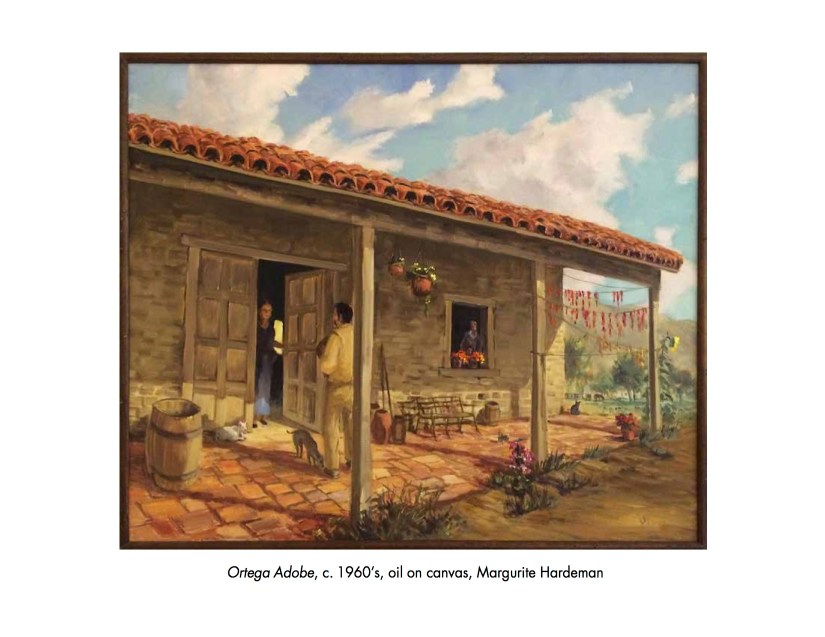
Art Tales photo

                                                                     House of Dreams


María Conception awakened with a sharp intake of breath. Why did the man in her dream try to grasp her hand? He was a shadow, but his presence familiar.

The sun burned hot through the muslin curtains covering the window. She pulled her damp nightdress away from her chest and rose slowly, allowing her arthritic knees time to acclimate to movement. The clatter of pots, a knife chopping against a heavy board, and the kettle whistling sounded through the room.

Her legs moved slowly, shuffling towards the nightstand and the pitcher of water. After a rinse of cool water on her face, she stroked wet palms over her silver mane, twisted a rope of hair to the nape of her neck.

Buenas días, Doña María.” Her new daughter-in-law wiped her hands on a faded blue apron before she took an earthenware cup from the cupboard. “The coffee is ready.”

“Maybe today,” Maria Conception said noticing lines of worry across her daughter-in-law’s forehead. She sat heavily on the wood chair, its seat smoothed from years of use.

Both women cast glances towards the kitchen window, searching the sky for answers, wondering if bad weather approached or the bloated clouds were passing through. “I hope they return soon,” her daughter-in-law said.

Woven baskets filled with chiles sat next to the charcoal brazier, ready for roasting. “Canning day,” María Conception said. Soon, the familiar scent of burning coal and the sting of chile vapor rose, filling the home, before escaping through open windows.

María Conception instructed her daughter-in-law on the correct way to make chile sauce and the virtues of canning. She needed to know the Ortega family’s cooking secrets so she could provide for an unstable future when it arose. She began with the telling of the family history.

Their adobe, given to them in a land grant, stood on Chumash land spanning the years between Mexican territory and California statehood. Emigdio, María Conception’s husband, built the house.

She remembered the day he returned with his horse sweaty from pulling the carreta filled with redwood beams he found in an abandoned adobe in Rancho Sespe. Their river rock foundation would now have an equally sturdy roof. “A good home,” she said.

They raised thirteen children who worked their fields, tended the goats and provided for their needs.Their adobe withstood the flood of 1867 and the fire which burned their rafters of giant reed cane tied with rawhide. The odor lingered for months. The rugged beams survived, slightly scorched. “A miracle,” María Conception said.

Minutes passed to hours as the chile roasted, was peeled, and plucked clean of seeds. Unspoken anxiety stretched in the space between the two women. María Conception rocked in the oak chair her husband carved decades before. The rhythm, a comforting pulse, creaked to a stop.

A knock on the door boomed and paused, followed by rapid taps. María Conception looked through the window where Mr. Sanchez stood, his hat in his hand, and she knew what her dream meant.

#

This story is fictional however some of the characters are based on fact. Emilio Ortega, Emigdio and Maria Conception’s 11th child, established the Ortega Chile Packing Company using his mother’s recipes. The company has a variety of products on the market.

Healing, Latino culture, Loss, Mexican traditions, Writing

Do You Know How to Use a Curandera?

Mexican Seri Woman Crossing the Desert
Mexican Seri Woman Crossing the Desert photo by Gabriela Iturbides

Do you know how to naturally heal fright or trauma? No? More about susto later.

During the last two years, I’ve worked on a story about an ambitious twenty-one-year-old with a ten-year plan to become a State Senator who drops out of college because of a broken engagement. She meets a grandmother and granddaughter who are curanderas. Although she doesn’t believe in this Mexican tradition of healers she takes matters into her own hands and makes a love potion. When the wrong people, her mother, ex-fiancé and others, drink the potion and fall in love she has to discover an antidote. Her search takes her to Oaxaca, Mexico to meet a curandera who may be able to help her heal her susto and give her the correct potion to make things right.

city of Puebla, Mexico
Puebla, Oaxaca, Mexico photo by Russ Bowling, unsplash.com

When I was a kid, every mother knew of a local curandera. Using their services was normal. For centuries, the Mexican culture has had curanderasSome cultures may call these people shamans, or medicine men or women. Some people call them, incorrectly, witches. 

Curanderismo is a healing art and a curandera/o is a healer who uses herbs, ointments, massage, and cleansings to cure an illness and do spiritual and psychic healings. They and the community believe the curandera has a spiritual calling to heal. They are often descendants of other curanderas.

mayan, healer, maya
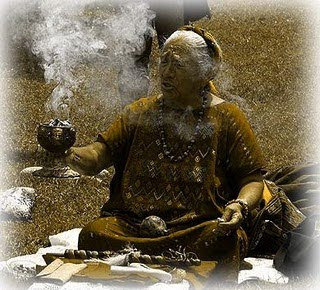
Margarita, Mayan Healer

The photo above shows a Mayan healer in Mexico. In the U.S, and my experience, the curanderas were usually grandmothers wearing aprons or elderly men in work clothes who conducted their ritual healings in their home or garage. Now they are more likely to work in a botanica which sells candles, oils, herbs, and other items such as amulets.

Using the services of a healer involved a small fee or a barter. This is probably why most Mexicans and Mexican Americans used a curandera. Either a doctor visit was too expensive, wasn’t available, or the doctor dismissed an ailment. Here’s a link to a doctor who discusses traditional remedies.  

But back to healing fright or susto. It seems there are degrees of susto. A person can be suffering a shock, an emotional trauma, or be in such a state of anxiety that they can’t function; which is the case with my main character in my novel in progress. When this happens, they are said to be suffering from susto.

A spiritual cleansing, limpia,  is often used by taking a bunch of selected herbs made into a small hand broom which is whacked across the entire body. This removes negative energy. After this, an egg is held above the head, moved around the body, and cracked open into a container which the curandera inspects. Why an egg? It is believed that an egg has the natural ability to absorb engergies around it. Finally, water is spit on the person. I know, sounds strange but this is what happens.

Curanderismo is not only a Mexican tradition but one that is found in most of Latin America and the Carribean. The subject is one that has fascinated me so much I had to write a novel (work-in-progress) featuring curanderas. Take a look at my storyboard for this novel. You may come across some interesting information.

Disclaimer: This post is not suggesting you use a curandera in lieu of a medical practitioner; that is your own decision.